Showing posts with label Euro2012. Show all posts

Tuesday, 27 March 2018

Italy's Familiar Unfamiliarity With England

Daniele De Rossi takes the questions before Italy vs England
Ahead of the friendly between Italy and England tonight at Wembley, looking back at the build-up to the Euro 2012 quarter-final reminds us of the complicated footballing history between the two nations.   

Italy's Daniele De Rossi, amid the battery of Mario Balotelli questions, gave perhaps the most telling response to how Italy felt going into their quarter-final match against England in Kiev on Sunday: "It would have been better to have played Ukraine, but it's okay like this as well."

That Italy would have preferred, with all due respect, Ukraine to have gotten through is obvious, but I think they would have preferred playing France to England as well, and this despite
Les Bleus having brought so much pain to Italy in World Cup 1998 and acutely in Euro2000. Even if De Rossi had been all bravado in front of the media, it would have been a hollow performance, beyond the tiring platitude of press conference in football.  Unmistakably, Italy are distinctly uneasy about playing England. 


While English opinion has, for not an insignificant part, been impervious to Italy's successes, operating in an obsolete currency that still circulates notions like Italy play defensive and cynical football, Italian opinion of English football can be frayed at times by the pressure of the occasion, but at the core is built on an almost fearful respect.


Sure, Paolo Di Canio may have said that Roy Hodgson's men remind him of an "Italian team of the 80s," but he was not suggesting that England have regressed.  If anything, Italy know that this England team has teeth: Hodgson has predicated a revival of spirit and self-belief on Fabio Capello's organization.  At times this organizational form has threatened to disintegrate in this tournament, most notably against Sweden, but it remains intact.

But quite apart from how England "set out" in a game, there exists in traces a cultural deference in Italy for English football and its players. "[Steven] Gerrard remains my idol," said De Rossi.  Considering De Rossi is only three years Gerrard's junior and a World Cup winner, I found the praise a bit exaggerated.

There is a historical precedent for this kind of flattery, a precedent that was rooted in a clear dislike for the English as well.  In the 1930s, Italy were crowned World Champions twice under the aptly named Vittorio Pozzo.  However, there remained a need to vanquish the creators of the sport, the team who were considered superior despite having not entered any of the World Cups during the 1930s.  England were still seen by the English themselves, and to be fair, by many others, as the best team in the world.  And of course, politically this need to vanquish the English was also rooted in Fascist ideology that depicted them as "imperialists and gluttons" (Foot, Calcio, 479).

Vittorio Pozzo 
One of the most high-profile matches between Italy and England during this time took place on November 14, 1934. Italy were the reigning World Champions but the game was seen, in the words of John Foot, as being the proper "deciding play-off": "The winner of the game would be declared--unofficially--as the best team on the planet" (Foot, Calcio, 479).

Italy lost the game 3-2, but it hardly matters now in the broader calculus of superiority, in which there is absolutely no contest: Italy have won four World Cups to England's one, and one European Championship to England's zero.  At club level too, despite the bellowing of Liverpool and Manchester United fans, not one English club has seized Europe the way Il Grande Milan did in the late 80s and early 90s.

Yet, currently, the Premier League remains the pinnacle of modernity, with only the German Bundesliga rivalling it for commercial power.  Serie A, on the other hand, has been plagued by scandal, financial mismanagement, dilapidated stadia, and racism.  On the field, however, notwithstanding the fragmentation around it, Italian football remains singularly clear on the importance of success.  English clubs, though, have always presented huge troubles for Italy in Europe--not just on the field either.

The Heysel Tragedy of 1985 remains a plaintive and infuriating chapter for Italian football fans, specifically those of Juventus.  The thirty-three Juventus and six Liverpool fans who were smothered to their death as a result of English hooligans inundating a section containing Juve fans always tartly contributes to the narrative of Italy and England.

On the field, there is of course the heartbreak of Roma and Milan losing to Liverpool in the European Cup finals of 1984 and 2005, and, most recently, Milan having trouble with English opposition between 2008 and 2011, during which time they were eliminated from the Champions League by Manchester United, Arsenal, and Tottenham.

While Italian clubs have indeed recorded memorable victories over English ones in Europe (Milan defeating Manchester United and Liverpool to 2007 glory, and Napoli, most recently, gliding past Manchester City), there is a tendency to believe that English football has the requisite antidote to the Italian game: an athleticism, a sense of width that troubles Italian teams.

Tardelli gives Italy victory over England
But international football is not the cumulative expression of club football.  Success in it depends on psychology and many tactical choices based on pressures of time, and both Italy and England have had a frenzied build-up to the tournament.  England had a managerial reshuffle with Capello making room for Hodgson, while Italy had to deal with the scandal that saw their valued left-back Domenico Criscito sent home.

The Azzurri may have some apprehension going into the game tomorrow, but they know they have what it takes, in theory, to beat England in a proper tournament.  The third-placed play-off in World Cup 1990, while memorable, was an afterthought, and Italy's last victory over England in a tournament before that came thirty-two years ago in the 1980 European Championships when Marco Tardelli gave them a 1-0 victory.  Italy and England have only played twice in major tournaments, which lends a mystique to the quarter-final on Sunday.

Given the success Italy have had over England internationally, their apprehension may seem misplaced.  Sunday will be a psychological tussle between two teams who have a lot of history around them, but only a bit of competitive history between them, directly on the field.  It is this familiar unfamiliarity that colours this contest unpredictably.  Ludicrously, despite their high-profile, England remain a bit of an unknown quantity for Italy, and vice-versa, but I get the feeling, based not on empirical reality but my own unscientific hunch, that England can accommodate that unfamiliarity by the strength of their own conviction (I still don't believe that this accommodation will lead to an English victory by any means).

I have read, on more than one occasion, that Italy are not a real threat to this English team, and the fact that Spain were avoided is a cause for understated celebration.  Certainly, on paper, Italy appear to be a more manageable opponent than the reigning World and European Champions, but it is precisely paper that cannot contain or define this game.  To me, Italy and England on Sunday is still an unknown, which makes it intriguing, but also frightening.

Forza Azzurri!

Wednesday, 27 March 2013

Beware of Beautiful Italy


Prandelli, Buffon & Pirlo display Italy's Confederations Cup jersey  
Cesare Prandelli's resurrection of Italy after the 2010 World Cup is now not merely a revival of results and spirit.  That was the prosaic job requirement anyway, and one that Prandelli quickly checked off.  No, Prandelli has done much more: he has aestheticized Italy's resurgence.

For the neutrals over the years, the Italian national team has, at best, remained unchanged.  Despite the compelling evidence much, much to the contrary, the hackneyed opinions faithfully did the rounds.  That is, that Italy are a calculating, sneering team, who retreat into defensive cowardice when the opposition is in delightful attacking flow.  And of course, the logical conclusion is that Italy are regressive, and teams like Spain, Germany, and even, laughably, England represent the way forward.

Most of these purveyors of decency don't evoke Claudio Gentile's fanatic marking on Maradona in the 1982 World Cup as clinching proof of Italy's congenital wickedness, but that is simply because their memories and knowledge don't stretch that far back--or, at all.

Yet, you can't dismiss this sort of parochialism off-hand because, despite its flaws, it has led many to dismiss Italy. The truth is, had Spain not finally discovered the Philosopher's stone in 2008, Italy would probably be getting a lot more credit right now.

The Azzurri have become one of the most watchable sides in world football under Prandelli.  Sure, Spain have their brand of hypnotic foreplay, and Germany their cocksure decisiveness, but Italy are developing a calm, considered self-assurance that has harnessed even the libidinal energy of Mario Balotelli.

That they are topping their qualifying group by three points with a game in hand should come as no surprise, but they have also played a football that is barefaced, unrestrained in its directness.  There was evidence of that during the last European Championship, and more of it this past week.

Italy's 2-0 win over Malta in the World Cup qualifier on Tuesday had some stutters but was ultimately routine; yet, their 2-2 draw with Brazil was a re-narrativization that cast the South Americans in a bit-part role.  In the end 2-2 was immense flattery for Brazil. Italy looked like joga bonito; Brazil, a team striving to make acquaintance with themselves.

Admittedly, the Brazilian national team has been soul-searching for a few years now, but that also enhances belief in Prandelli's craft--in such a short time, he has made Italy a resounding success, and one that is easy on the eye.  Also, look around Europe.  National teams are generally underwhelming right now.  England look poorer with each game, France have yet to find their feet, and Germany, despite promising so much, failed when it mattered most at Euro 2012.  After Spain, Italy are doing what they are doing best.

Easy, this: Balo celebrates goal against Brazil
Whether Prandelli's Italy flows better with 4-3-3 or 4-3-1-2 will undoubtedly be covered by the expert
analysts for months to come.  What really sticks out for me is how Italy have relegated that talk to the periphery.  It is almost as if whatever formation Prandelli comes up with, this Italy will be competitive, and beautifully so.

Milan full-back Mattia De Sciglio and forward Stephan El Sharaawy are just two of the more notable additions that Prandelli has made to the national team, and both have capitalized on a more capacious Italy, one that allows for an expression of young, untried talent.

And let's not forget that Italy were one game away from being crowned European Champions this past summer, but Spain had too much for them.  But, it is not scandalous to say that the Italy that drew 1-1 with Spain in their opening game of Euro 2012 was closer to the truth than the tired and spent one that disintegrated in Kiev.

Italy also dominated England and Germany en route to the Final with a brand of football that witnessed neat shorter passes (see the build-up to Mario Balotelli's first goal against Germany) and also a more direct aerial route (see the brilliant, heat-seeking pass by Riccardo Montolivo to Balotelli for the second Italy goal).  The football was vivacious and liberated, not stifled and stuck in the old defensive school.

This Italy is a dynamic one, despite drawing all of its starting line-up from Milan and Juventus on Tuesday.  It is to Prandelli's and the Italian press's credit that they largely made the selection a non-issue, restoring belief that the group was more important than any regional allegiances, allegiances that have hindered Italy in the past.

However, despite the collective, marshalled so ably by Prandelli, as has happened so often with Italian football, there was one player who still managed to outdo and outshine his teammates this past week.  The newest fuoriclasse is Balotelli, the man who tore Germany apart this past summer, and the man who was in tears after the Euro 2012 Final.

He also scored three of Italy's four goals in the last two games, one a stupendous shot from outside the area against Brazil. His fire will be vital for Italy during the World Cup in Brazil, and if Prandelli continues his unheralded revolution--the next test of which will be the Confederations Cup this summer--Italy may go very far.

Saturday, 8 December 2012

And here I am, Italian football

Get used to it: Ibrahimovic is presented as a PSG player
It has been a long time since my last post.  The Euro2012 Final was not exactly heartbreaking as it was sobering, and the disappointment of losing a Final disappeared quickly thereafter.   So, I can't attribute a five-month absence to a 4-0 drubbing at the hands of the best team in the world.

No, the reason I had no will to write about Italian football for so long was because of Italian football--not its performances on the field, but more off it.  Two things encapsulate my displeasure.  Let's take a  look.

First, and acutely for me, there was a hideous denouement to the whole Zlatan Ibrahimovic and Thiago Silva affair.  Selling them to PSG was a capitulation to the most vulgar truth of modern football: the nouveau riche are not simply upstarts but ones who can goad the slightly willing into selling half their team overnight.  That is precisely what happened, if not in number then in quality, when Milan sold Silva and Ibrahimovic.

In selling Silva, one of the best defenders in the world, Milan pioneered a market manoeuver of shocking duplicity, which stands alone in its callousness towards fans.  When PSG got serious about Silva and were tantalizingly close to getting him, in stepped, predictably, Silvio Berlusconi for the colpo di scena, sparing fans and Silva alike from the indignity of selling their team's foundation to a team that flashed a little cash.  I am being reductive here, as there was more to it than Berlusconi, but it was he who headlined the rescue.  

Silva renewed his contract, and Milan fans could breathe a sigh of relief at least for the 2012-13 season.  However, a few weeks later, Silva was sold remorselessly to PSG.  It was cruel even by Milan's recent standards.  The fans least suspected it because a contract renewal has been a time-honoured gesture of the player and the club to continue their relationship at least for the subsequent year.  But Milan relinquished tradition a long time ago. 

And then there was Ibrahimovic who was hastily and gracelessly shown the exit as part of the package deal. The Swede is not generally known for his retreating disposition, but he has every right to despise the suits at Milan, and by all accounts he does (he and Galliani don't talk now).  Milan didn't spare him any indignity.  They wanted him gone if Silva was gone, which is not a very edifying approach to dealing with a player who had allowed Milan to stand on his shoulders and grab a Scudetto in the two seasons he was there.   

The protest and response in Italy was surprisingly muted, leading to speculation that Galliani had perhaps promised something to the hard core of the Milan contingent, the Curva Sud.  This cadre has always been at the forefront of Milan mirth, madness, and melancholy over the years, but their protests were tame by their standards and they have, to their credit, supported the team through a disastrous start to the season.  Lest we forget, Milan's season is now recovering, unlike my faith in the men leading my club.   We are at the whim of Berlusconi until he decides to sell. 

Andrea Pirlo and Claudio Marchisio
Secondly, and more succinctly, Legge Crimi, the stadium law that I have written extensively about has still not been ratified. In its jarring absence, there have been some promises by Roma and Inter for a new stadium, but those projects are slated for 2016.  The toxicity of the legislative bodies, local councils, and politicians in Italy is staggering. Vested interests have once again trumped broader utility.  The law that would allow teams to refurbish their dilapidated homes is still on standby, and so are the potential revenues that could be realized by these clubs on matchdays.

This event and non-event are symptomatic of what is totally rotten in Italy.  The suits lie and dither, and Italian football suffers.  But that is why I'm back.  I have to write about Italian football even when it is lurching from one crisis to the next.  I have been for a while now, so why not continue?  At the very least, the textual trace will give the chaos and hopelessness some form and geometry.  

And of course, there are some plus points.  On the field, Italian football is showing signs of hale. In Europe, five teams are still alive.  Juventus emphatically announced their return to the big time by flattening the reigning European Champions Chelsea 3-0, a victory that allowed the spectator to anatomize how effective Juventus really are.  A midfield of Claudio Marchisio, Arturo Vidal and Andrea Pirlo could even play behind invisible men and still make inroads into the opposition half at will.  Speaking of invisibility, even in Antonio Conte's conspicuous absence (he is serving a harsh ban), Juventus are still at the summit of Serie A (though they have lost to Inter and Milan this season), and have just finished top of their Champions League group.

Lazio, Napoli and Fiorentina have been impressive as have been Inter.  Milan started the season poorly, but Stephan El Sharaawy, Riccardo Montolivo and at times Bojan have shown that Milan can predicate a revival of fortune and spirit on these younger players (Montolivo at 27 being the geriatric among the three). There is hope because Italian football, as I have written about countless times, as a philosophy, as a way of playing, is still powerful and effective.  Italy just went to the Final of Euro2012, humiliating England and soundly beating Germany on the way, and this year's football in Serie A has been compelling, even exciting.

Considering the cynical bureaucrats running the game are disinclined to bring about real change, the coaches and players deserve immense credit for their effort.

Forza Italia!

Saturday, 30 June 2012

Azzurri, We Love You

Balotelli embraces Cassano as Pirlo looks on
It seemed already decided before a ball was kicked in anger at Euro2012: Germany and Spain, the two best teams in Europe, would play the Final.  On the one hand, you had a German team that had been honed for the occasion, a redoubtable unit that was the apotheosis of speed and precision.  On the other, you had a Spanish team that was destined to keep the ball from everyone by virtue of a biological imperative.  These were two teams with a distinct identity, built and burnished over years of hard work. Even UEFA president Michel Platini couldn't stop from gushing over the prospect, unreservedly admitting that he would like to see Germany and Spain in the Final.  

Italy, though, had other ideas.  On the eve of the tournament, when asked about yet another scandal extending its fingers into an Italian squad--
and grabbing his stand-out left-back Domenico Criscito in the process--Italy coach Cesare Prandelli, perhaps exasperated at how people had trained their attention on extracurricular matters, responded disarmingly: "If it suits everyone, we are ready to withdraw from the tournament." 

It was the candour of the response that was notable, incisive.  A tactful man like Prandelli had been pushed and pushed, and the strain was beginning to peek out from under him.  Italy's preparations for the tournament had been chaotic not just because of the scandal, but also because of preparations that exposed, at the time, how ill-prepared Italy were.  Their first friendly against Luxembourg scheduled to be played in Parma was cancelled because of an earthquake, and their second against Russia, a 3-0 defeat, was a humbling insight into what needed to be done.


I, and many
Azzurri devotees will agree, am thrilled that Prandelli and Italy are still here, and that no one took Prandelli's suggestion too seriously.  Italy took on Spain on June 10 and Germany on June 28.  Both games should have confirmed that Italy were still outside the very elite, a notch below the two competitors that were to battle in the Final in Kiev, on July 1st. They didn't.  The 1-1 draw with Spain in Group C's opener, and the resounding 2-1 semi-final win over Germany have instead pushed Italy into the Final on Kiev against Spain.  The predictions were only half-right.

Thursday's win in particular stands out as one of the proudest moments in Italian football.  Quite apart from the fact that Italy dismantled Germany (I won't be covering how, here--you all probably saw it) the game definitively established one signal thing: it made Italians, and even some neutrals, fall in love with
this Italian side.

Prandelli  during the semi-final
The question has been asked on more than one occasion now, and the answer from many is that this Italy is almost as loveable as the ones from 1982 and 2006.  Up front you have the combustible duo of Antonio Cassano and Mario Balotelli.  The former is here even after a stroke he suffered this past season, and every time he breathes heavily, I get nervous.  But the way he swivelled past the German defenders to set up Balotelli's first goal shows that there is blood pumping unabated.

Balotelli, the unmistakeably real sociocultural response to  Lega Nord and those "fans" who think that a black man can never be Italian, is Balotelli:  the perfectly poised reflexive property that needs no other qualification.  Balotelli is indeed Balotelli, and he is also Italy's great hope going into the Final against Spain.  His brace against Germany definitively heralded his arrival after his stupendous goal against Ireland had hinted at it.

In midfield, Daniele De Rossi, Claudio Marchisio, and Andrea Pirlo have shown that you don't have to have a Spanish midfield to be eminently good: the trio have been the vital signs for Italy.  Pirlo has moved as he has wished, tuning out the raucous atmosphere of matches to let the slow, soothing cadence of his own game guide him and his teammates.

In defence, Gianluigi Buffon, the vociferous goalkeeper who rallies perpetually, has been the clearest expression of this Italy's tenacity.  Remember, it was he who was irate when Italy let Germany have even a glimmer of hope at 2-1, so late in the game. Leonardo Bonucci, Giorgio Chiellini, Andrea Barzagli and Federico Balzaretti have been playing superbly together, so much so that Prandelli has no intention of reverting back to a 3-5-2.

And then there is Prandelli himself, one of the most likeable characters in Italian football.  A consummate professional, who remains dignified in scandal, victory, and defeat, the 53-year-old has made people fall in love with this Italy, after Marcello Lippi had left it in disarray following the 2010 World Cup.

No matter what happens on Sunday, this is an Italy to be loved.  But I urge the Azzurri to play with the same assertiveness as they have lately.  "We are not afraid of Spain," Prandelli said, and so they should show it.  They have our support.

Forza Azzurri!

Monday, 25 June 2012

Azzurri: Eloquent, Decisive, and Devastating

Magic...Andrea Pirlo shows how it is delicately done
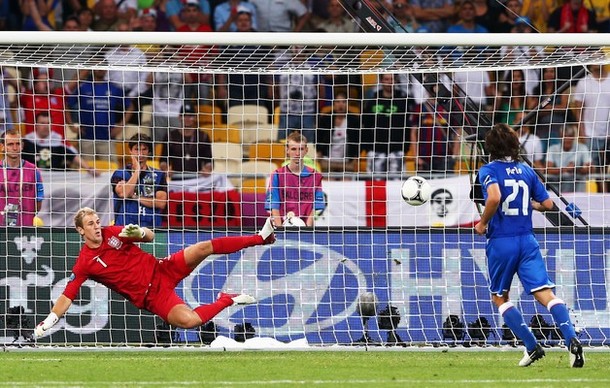
It was all about the chip.  One hundred and twenty minutes plus penalties, and it was one nudge, one impudent scoop, restrained in economy, expansive in affect that encapsulated Italy's total dominance over England.  When England goalkeeper Joe Hart sprawled across, watching the ball agonizingly sail past him, Andrea Pirlo had punctuated the penalty shoot out with an ellipsis. What he did was simply ineffable.

"Maybe my penalty put pressure on them," said Pirlo, with the same understatement as his penalty.  It did.  It shattered England, and it made Hart's antics to put off Italy's penalty takers seem like he was mentally ill.  The two Ashleys, Young and Cole, could not follow up Pirlo's virtuoso act even with a competent one.  It was men against boys, weak-mindedness against cerebral force.

It would have been a travesty had Italy lost the penalty shoot-out.  Before the game, a conspicuous portion of English opinion had predicted Roy's Boys to edge through somehow.  This team worked together, for each other, for a purpose, we were told.  Their flaws become their strengths, you see.  Their sum is much greater than their parts.  Sure, they didn't have the greatest midfield, and sure they hadn't performed coherently once this tournament, but they knew how to get results.   It was all pathetically wrong.

Italy came at England in waves, passing the ball around--yes, around them, about them, and through them.  Blue shirts swirled around white ones like winding patterns of ink.  At times it was embarrassing.  The statistics make for crushing reading for England.

Italy had 68% of possession and 36 goal attempts to England's 9.  A country whose punditry devotes a good chunk of its time denigrating defensive football that seems, to them at least, to be the sole preserve of Italian football, played not defensive football, but no football at all.  It was a cipher performance.  Glenn Johnson's almost-goal in the first few exchanges receded into distant memory as Italy took ownership of the Olympic Stadium's real estate.

Italy celebrate their triumph over England
Somehow, however, like his players, Roy Hodgson completely misread the game.  Unrestrained in his delusion, he said England had been "heroic."  Misreading is one thing--this is downright illiteracy.

Yet, Italy do have some things to sort out.  Daniele De Rossi's curving shot that hit the post, his subsequent near-miss, Mario Balotelli's inability to pull the trigger, and Riccardo Montolivo's huge miss in front of a gaping goal should have crowned Italy's approach-play.  It didn't, and that, amid all this euphoria, is a concern going into the semi-final against Germany on Thursday.  How Italy would love a Christian Vieri or Filippo Inzaghi right now.

For now, though, it is time to celebrate. It is time to celebrate Pirlo and Gianluigi Buffon, whose save on Ashley Cole twisted the dagger that Pirlo had initially sunk.  It is time to celebrate Alessandro Diamanti, a model of serenity before the clinching penalty.  It is time to celebrate coach Cesare Prandelli, who believed in this team, and who remains self-effacing as ever.  It is time to celberate Gli Azzurri.

Forza Azzurri! 

Tuesday, 19 June 2012

Italy Optimistic Despite Struggles

Italy celebrate their progress to the next phase
3-5-2? 4-3-1-2? Biscotto? Those were the questions oppressing Italy coach Cesare Prandelli, his players, punditry, and fans before Italy's critical game against the Republic of Ireland.  But it was Prandelli who somewhat accurately described what was the most significant reason for Italy to go through to the quarterfinals.

"Today we understood that determination made the difference, and not just our quality," said the coach in the post-match conference, the tension slowly dissipating from him after what he called the toughest game of his managerial career.


In fact, Italy's quality was a rare sight yesterday, rarer than against Spain and Croatia, and even their determination, at times, threatened to veer into panic, as the players started to look at the clock well before full-time.  It wasn't until Mario Balotelli's absolutely staggering goal to make it 2-0 that Italy exhaled.  Well no, that's not entirely true.  They had to wait for news to filter in from the other game between Spain and Croatia, which the former won, before they could fully let go and exult.


The victory yesterday was Italy's first at a major tournament since their 2-0 defeat of France in Euro2008, and it came after football that was less than convincing.  But this has been typically the case with Italy in decisive group games in recent memory (World Cup 2002, Euro2004), and yesterday, too, 
there was the customary drama that accompanied Italy's final group game.  

Most important, however, is to understand that Italy have shown a distinct struggle for consistency and identity during their first three games at Euro2012.  Against Spain, Italy were convincing for the most part, against Croatia they were tired, and against Ireland they were nervous.


The only palpable thread uniting all three performances has been the quality of Andrea Pirlo, who should be wrapped in the softest silk if Italy are to have a hope in this tournament.  His feet have been poetic even at 33.  He described yesterday's game as one of his "worst," but even then it was he who set up Antonio Cassano's goal, and it was he who calibrated, admittedly only at times and not as effectively as in the other two games, the pace of the game according to his mood.


Bonucci tames Balotelli
Daniele De Rossi was solid all three games too, but further up the field Italy still have to discover their best combination.  Playing Thiago Motta behind the strikers in a 4-3-1-2 was not extremely effective, and it is still unclear whether Prandelli will start with Antonio Di Natale, who had a decent game, or Balotelli.  I would guess Balotelli will start the next game.  Remember, too, that Fabio Borini has also not seen playing time yet, but perhaps he will have to be content on the bench.

Lest we forget, of course, there is also the constant question of whether to play three or four at the back.  Italy don't seem to have the fitness levels for the former option, and with Giorgio Chiellini potentially injured for a couple of games, it seems four at the back may be the way to go forward (figuratively and literally), not least to include Federico Balzaretti, who was impressive last night.

All things considered, I am optimistic.  I think as cliche as it is, I agree with Claudio Marchisio when he says that "Italy's tournament starts now."  Italy will play one of France, England, and Ukraine next (most probably France), and there will be a need to impose themselves on their opponents.

That means Cassano has to do even more than he has, and Balotelli needs to understand--really, understand--that his superb technique, on display in full technicolour yesterday, is the precise genius that Italy are craving (incidentally, Leonardo Bonucci's muzzling of Balotelli after the latter's goal was the most endearing moment of the tournament thus far).

This Italy can reach the Final, as Marco Tardelli and Giovanni Trapattoni said yesterday. Prandelli also concurred, though he didn't put it as confidently in the affirmative.

"Now, nothing can be excluded," Prandelli has been quoted as saying by Tuttosport.  On the balance of the three games the optimism may seem misplaced, but Italy are soaringly confident now that they have wriggled past the World and European Champions, an imposing Croatia side, and an Ireland who, under Trapattoni, was supposed to give them problems.

It is perhaps what was needed to lend sharp relief to Italy's slowly evolving self-realization in this tournament.


Thursday, 14 June 2012

Italia...perché?!?!

Like the smoke around Buffon, Italy's Euro2012 future is unclear
So, like I said cautious optimism was needed after the 1-1 draw with Spain.  Italy now go into the last game of Euro2012 knowing, just like they did in 2004 and 2008, that even a win will not be enough. More on that later...let's talk technical stuff now.

Like in 2004, Italy know even a win will not guarantee anything as a draw between Spain and Croatia and a win for Italy against Ireland will mean all teams would be on five points, but results against Ireland would be irrelevant then--a mini-table between the three teams would be formed. Italy's careless 1-1 draw with Croatia and Spain's 4-0 hammering of Ireland mean that even if Italy were to win handily against Ireland a score draw of 2-2 or higher between Croatia and Spain would knock Italy out.

At this stage, Italy can qualify without complications if there is a winner between Spain and Croatia, and Italy simply beat Ireland, who are, of course, already eliminated.

Other scenarios are more complicated.

If Italy win against Ireland, and Croatia and Spain ends in a 1-1 draw, then Italy, Spain and Croatia will all have 5 points and an identical goal difference and goals scored record.  In that case, the team who has the best goal difference in the entire group will go through (that would mean results against Ireland would come back into consideration).

In 2004, Italy were in the exact same position, and their worst nightmare came true: Denmark and Sweden drew 2-2, and Italy went out despite having beaten Bulgaria 2-1.

It is never easy for Italy.

Here are the UEFA tie-breaker rules:

1) Highest number of points obtained in the games between the tied teams in question
2) Goal difference between the teams in question
3) Goals scored between the teams in question (in the matches they played against each other)
4) Goal difference in the entire group
5) Highest number of goals scored in all games of the group
6) UEFA coefficient position
7) Fair play record in the tournament
8) Lottery

Monday, 11 June 2012

Azzurri Need to Confirm Impressive Start

La Gazzetta dello Sport brims with admiration
By all means, and by all accounts, Italy should celebrate with vim and gusto their 1-1 draw with Spain in the opening match of their Euro2012 campaign.  After all, taking a point off of the reigning European and World Champions should be a restorative jolt to the Azzurri, who were written off by every pundit I listened to or read before the tournament started.   Lest we should have been concerned, there were the perfunctory, "Italy are always unpredictable," or "you can never write off the Italians."

In fact, yours truly also polished off an article that had Italy "fighti[ng] for fluency" less than a week before the big tournament.  Of course, my less circumspect side wanted to write an article with green and red letters, with about two dozen exclamation marks (six of them side-by-side), but I will save the font-porn until Italy get out of their group.

The truth is with Italy you never know what you're going to get.  It wasn't as if I was trying to insure myself against humiliation if Italy were to do well at the tournament; it was more that I was genuinely bewildered as to how a team that was struggling to cohere a few days before the tournament would fare against the Spanish.  I'm happy that they fared well despite a few incidents like when Mario Balotelli heard Zack Morris call '"time out" a few inches from goal.

There has been much said about the game.  And why not? I personally would like to say Antonio Di Natale's goal in the 60th minute was a vindication of Italian football's core truth, which is not solely rotten like the latest betting scandal.  Instead, it also proffers us a man like Di Natale, ensconced at a club like Udinese, having turned down an offer from Juventus a few seasons ago.  At 34 and with 23 goals this past season, he came off the bench, and with his first touch showed Balotelli how it's done.  He knows where the goal is even when facing the redoubtable Iker Casillas.  Seriously, how tidy and sweet was that finish? Beautiful.

Yet, I urge cautious optimism.  If Italy are notorious slow-starters, they have also had breezy false starts before.  In Euro1996, they looked to be on course to qualify for the next round after beating Russia 2-1 in their opening match; they didn't.  In World Cup 2002, they comfortably beat Ecuador 2-0, but only just made it out of their group.  

Croatia await Italy next.  Remember Italy haven't managed to beat the team since Croatia's independence, and Croatia also defeated Italy in their second group game at the 2002 World Cup (albeit controversially).

More important than whether Daniele De Rossi should play in the center of defence (where he was outstanding by the way) or whether Di Natale should start (he should by the way) is how Italy approach their next game mentally. 

"Our next game will be the most important of the group," said coach Cesare Prandelli, echoing what he told World Soccer a few months ago as well.

"Croatia are a dangerous and unpredictable side."

Indeed, Prandelli seems to get it. Beat Croatia, and virtually guarantee your progress to the next round.  Anything less will make things a bit complicated.  It would be a shame to squander all the progress of 90 minutes against the Spaniards. Hopefully, Italy build on what they have started. 

But yes, before I forget, a very emphatic "Forza Azzurri!" from me!


Friday, 8 June 2012

Italy's Aching Need for European Glory

Facchetti lifts the Henri Delaunay Trophy in 1968
For all of Italian heartbreak at the World Cup (1970, 1994), and outright humiliation (1966, 2002), it is the European Championship that remains Italy's ultimate bête noire. Four World Cup triumphs are an antidote to the four agonizing years previously mentioned, but Italy have won the European Championship only once: in 1968, and even that victory came after a huge dose of luck.

Italy were hosts that year, a year that marked the first time the tournament was called the European Championship instead of the European Nations Cup.  The format of the tournament also slightly varied from the 1960 and 1964 editions: a group phase replaced the two-legged home and away knock-out round.  In the quarter-finals, Italy overcame Bulgaria, setting up a semi-final match against the then USSR.

After they battled to a 0-0 scoreline, and after extra-time couldn't separate the two sides, a coin toss resulted in Italy as the winner.  Incredibly, Italy were through to the Final through a method that made penalty shoot-outs look compassionately fair.

The Final needed a replay to decide the winner.  Italy and Yugoslavia battled to a 1-1 draw in the first game after Angelo Domenghini responded to Dzajic's opening goal for Yugoslavia.  Two days later, the replay saw Italy run out winners as Gigi Riva's and Pietro Anastasi's goals floored Yugoslavia.

It was a European triumph, but it came via a tortuous path, whose turns and twists prevented Italy from getting full credit.  That team had Dino Zoff, Giacinto Facchetti, and Riva, but it was the coin-toss semi-final win that pushed Italy to glory.

Since then Italy have had virtually no luck in the European Championships.  In 1980, for example, Belgium denied Italy a place in the Final by frustrating them to a 0-0 draw in the last game of the Group Stage.  Both countries finished on the same number of points in the group, but Belgium went on to play West Germany in the Final not on goal difference, but on goals scored--three to Italy's one.

In later years, Italy were eliminated at the Group Stage due to a combination of ineptitude and misfortune.  In 1996, Italy defeated Russia in their opening game, and looked to be on course for the quarter-finals.  However, a 2-1 defeat to the Czech Republic in the next game meant that Italy had to beat Germany to ensure qualification.  A draw would only suffice if Russia beat the Czech Republic in their final game.  In the 85th minute, Italy seemed to be inching towards the quarter-finals, as Russia were leading the Czech Republic 3-2 while Italy were deadlocked against the Germans 0-0.  However, Vladimir Smicer scored a late goal for the Czechs to eliminate Italy.

During Euro2004 in Portugal, Italy were left to rely on other results once again--and once again it was all in vain.  Italy had drawn 0-0 with Denmark in their opening game, and could only collect another point against Sweden in their second.  The results meant that Italy needed to beat Bulgaria in their final group game, and hope that the game between Denmark and Sweden not end in a 2-2 (or higher) draw.  Italy beat Bulgaria with Antonio Cassano scoring in injury-time, only to learn that Denmark and Sweden had indeed played to a 2-2 draw.  As news filtered through, Cassano sunk in despair in the Guimares rain.

A tearful Totti after the Euro2000 Final
However, as painful as those two European Championships were, the most excruciating fate awaited Italy in Euro2000.  Not many expected Italy to do well at the tournament being held in Holland and Belgium as coach Dino Zoff was without striker Christian Vieri and first-choice goalkeeper Gianluigi Buffon (both out injured) going into the tournament.  However, players like Stefano Fiore, a young Francesco Totti, and the peerless defensive trio of Paolo Maldini, Alessandro Nesta and Fabio Cannavaro inspired Italy to the Final where they took on France.

In the Final, Zoff opted to start with Marco Delvecchio and Totti up front with Udinese's Fiore playing right behind them.  Ten minutes into the second half, Delvecchio struck.  Totti laid a brilliant backheel pass on for Gianluca Pessotto, who crossed in low for Delvecchio to volley home past Barthez. Italy had played superbly up until that point and were deservedly in front.  Even after Del Piero, who replaced Fiore early in the second half, missed two supremely simple chances, Italy looked well placed to go on and win their first European Championship in thirty-two years.

However, a cruel--indeed tortuous--conclusion was yet to come.  With less than two minutes to go, Barthez cleared long up the field, and Cannvaro mistimed his header straight into the path of Sylvain Wiltord, who guided the ball past a helpless Francesco Toldo in goal.  Italian players looked totally deprived of strength and hope after that goal, and it was little surprise when David Trezeguet scored the golden goal winner in extra-time.

That game remains my most painful memory of football--more painful than Baggio's miss in 1994, and more painful than even Milan's farcical capitulation to Liverpool in the Champions League Final of 2005.  Italy came within seconds of winning that tournament, and the way they had played that Final in Rotterdam merited a win.

Between 1972 and 2008, Italy has had little to celebrate in the European Championship.  Here's hoping Cesare Prandelli and his side, against daunting odds, change that in Euro2012.

Saturday, 2 June 2012

Azzurri Fight for Fluency

Italy's Balotelli (left) and Russia's Ignashevich
You would think that after all that has happened with the match-fixing scandal in Italy, the friendly against Russia would be respite, an encouraging preview of what is about to come in a week's time--when Italy, you know, take on that eminently average Iberian team, Spain.

The preview was lurid.  Italy coach Cesare Prandelli watched his team flounder to a 3-0 loss to Russia, the defeat marking Italy's third consecutive friendly loss.

A lot was wrong, and not just Cristian Maggio at right-back, whose blunders were costly.  Throughout the game I had the same feeling I have had at different times during the qualifiers, but one that has now swelled into an overwhelming dread: this Italy does not know how to express itself fluently.

Indeed, for those eager to rebut the admittedly hackneyed argument that Italy are dour, dogged, and defensive, the statistic that Prandelli's side had the most possession of the ball after Spain during Euro2012 qualifying has been amply useful.  But what that statistic does not tell is that Italy have often looked like they don't know what to do when they have the ball.

The incisions in the final third have been nibbles around the opposition's goal.  When a promising move does actually materialize, no one has been able to capitalize on it for the last 270 minutes or so of football.

And so it went yesterday.  Prandelli started with Riccardo Montolivo behind Antonio Cassano and Mario Balotelli.  Coherent on paper, disjointed on grass.  Montolivo was featherweight, ghosting in and out of the game ineffectually, revealing only fleeting moments of competence, while Cassano and Balotelli gave glimpses of their repertoire individually but failed to combine their powers.  It was worrying because the two haven't played much together, and it seems like Prandelli will be relying on them significantly.

Andrea Pirlo, however, was at his heat-seeking-missile-accurate-best, oxygenating a stifled Azzurri with astoundingly accurate passes in the seventh and twenty-fifth minutes that should have led to goals.   But it was the rest of the midfield and defence that will cause Prandelli all sorts of tactical challenges.  Even before yesterday's friendly some urged for a three-man defence due to the absence of Domenico Criscito.  It would be surprising to see Prandelli switch so late in preparation, but he must somehow provision for better and more cover.  Russia approached and breached Italy at will.  Maggio was an absolute shambles at the back, while Andrea Barzagli seemed slightly unhinged.   Daniele De Rossi and Claudio Marchisio should have provided a bit more cover in midfield as well.

Italy conceded only two goals during qualifying but have shipped five in their last three friendlies. While many reached for platitudes in the post-match interviews, Barzagli was the most forthcoming, admitting that Italy "lacked balance."  That is perhaps the most dismaying thing for Prandelli to ponder: how to balance this lopsided team.  It is all the more dismaying when one casts his mind back to the fall of last year.  If you recall I wrote an article in September 2011 entitled "Prandelli's Azzurri Show Poise."  At the time things looked promising, but the last three friendlies have revealed a somewhat diffident side, unsure of the qualities it took months to cultivate under Prandelli.

Prandelli gives direction to Di Natale (left) & Giovinco
Prandelli's calibration over the next week will also need to contemplate what role Antonio Di Natale, the veteran at 34, will play this tournament.  He came on in the 68th minute yesterday, but his pace and ability to elude marking would have been useful earlier.  Di Natale remains a crucial alternative to Cassano or Balotelli.  However, he may also get a start if things don't tick after the first game against Spain.

More homework for Prandelli then, but the coach was quick to point out (justifiably) that this is also Italy's "third game in eight months," insinuating that the Lega Calcio's obdurate refusal to let him have some time with the players during the season has been a hindrance to the Azzurri.

With only a week left until the encounter with Spain, Prandelli has to defy the match-fixing scandal, an injury to Giorgio Chiellini (which should heal in time), Giuseppe Rossi's absence through torn knee ligaments, and the fact that his team only played one of their two scheduled friendlies--the first one against Luxembourg was cancelled because of an earthquake in Italy.  On top of that, the country's Prime Minister, Mario Monti, decided to jilt common sense and instead opt for the most drastic non-option available in the wake of the match-fixing scandal.  "I wonder if it would be a good idea to postpone Italian football for two or three years," mused Monti.

No, Prime Minister.  Absolutely not. Even though Prandelli said this week that he would be willing to take Italy out of Euro2012 if need be, Monti's suggestion and Prandelli's willingness though ostensibly noble are a bit bizarre.  Despite the predictable furor over the scandal, there remains an aching need for Italy to put in a good account of themselves during Euro2012.

There is no time to sulk.  There are many things to consider for Prandelli, not least important among which is how his team are actually playing on the field.  It is not so much formation that needs tweaking--at any rate, Prandelli was flexible during qualifiers switching between a 4-3-3 and a 4-3-1-2 as required--than a need for incisive eloquence from a team that purports to hold the ball more than we are used to seeing from Italian teams in the past.  There will be, after all, no time to stutter against Spain, a team that considers holding the ball their birthright.

Tuesday, 29 May 2012

The Familiar Gloom

Under investigation: Domenico Criscito
It seems all too familiar now.  Coverciano, inquests, investigations, raids, recriminations, and strident protests of innocence.  This is all preparing for a major tournament, Italy style.

For 2006, read 2012.  For 1982, read 2012.  Italy coach Cesare Prandelli picked a shortlist of players for Euro 2012 and the news Monday should have focused on who should stay, who should go, who should play where.  In the case of Domenico Criscito, he simply could not stay, so he went, and he will not play a part in Euro 2012.

On Monday morning, police arrived at Coverciano, the headquarters and training ground of the Italian Football Federation (FIGC), and questioned the left-back over his involvement in a match-fixing scandal that has already resulted in the arrest of Lazio's Stefano Mauri, who is by no means a low-profile player in Italian football.  Criscito's room was raided by police, and although he is still under investigation, he was told to pack his bags.  For Prandelli, for Demetrio Albertini, FIGC's vice-president and former Milan legend, his presence would have been too much of a distraction.

"Criscito won't be going," said Albertini. "He has to sort this out--it is understandable and the federation has supported the coach."

With less than three weeks left until Italy's opening match against reigning World and European Champions Spain, you could say, without being laughed at, the preparations could be going better.  As if the scandal wasn't enough, the elements have conspired against Italy too, it seems.  Today, their friendly against Luxembourg was cancelled because of an earthquake near Modena.

There is a perverted logic to all of this.  As dedicated optimists will tell you, whenever there are occurrences of this nature around the Azzurri, they perform.  As squalid as the latest match-fixing scandal is, the omen is good.

In 1982, Paolo Rossi arrived at the World Cup after serving a ban for match-fixing--he stormed the tournament, taking Italy to their first World Cup triumph in 44 years.  In 2006, Calciopoli 'broke' before the World Cup.  The debates around that scandal are well-rehearsed, but suffice to say here that the legal crusade of investigator Stefano Palazzi against Italy's biggest clubs concentrated, rather than dissipated, the Azzurri, resulting in Fabio Cannavaro euphorically hoisting the trophy in Berlin.  It was indeed quite the juxtaposition to read of Italy's progression at the World Cup, and the regression of their football back home.

Ashamed: Giovanni Trapattoni
That is the optimistic view.  While the view is comforting, it also tacitly privileges what should be a depraved sideshow.  To say Italy will win again this summer--and indeed I have hoped that the latest match-fixing scandal spurs Italy onto great things in Poland and Ukraine--is, in the end, also to trivialize what is happening.

"In the foreign media our image is abysmal," lamented former Italy and current Republic of Ireland (whom Italy play during the group stages) coach Giovanni Trapattoni.  "We should give a better account of ourselves."

Italian football's problems, from racism to crumbling stadia to match-fixing, inundate any account of its football.  It's a shame.  The latest scandal, which also involves Juventus coach Antonio Conte and his time at Siena, gives another opportunity to people who have had the knives out for Italy a long time ago.

Neutrals and non-Italian football fans, in my experience, despise Italy and Italian football with almost a venomous passion; as if they need any more excuses.  There may be a redemptive element to all of this, and I hope it shows itself, but for now it is a moment to reflect on how low Italian football can sink.  And for another increasingly rarer moment, I can agree with Milan vice-president Adriano Galliani, that it is a sad day, and there is not much else to say.

Since 2006, the publicized clean-up of Italian football has not drained the lifeblood of scandal--rather, persistent machinations have engorged it.  It seems that when it comes to Italian football, scandal is not only bizarrely an omen for succes, but also for more scandal.


I will be covering the Azzurri almost exclusively over the next month.  Keep visiting. Forza Azzurri!


Wednesday, 7 September 2011

Prandelli's Azzurri Show Poise

Cannavaro reckons Italy collapse
Fabio Cannvaro's head-in-hands reaction to Italy's collapse during the World Cup in South Africa seems so long ago now.  Italy's 1-0 win over Slovenia on Tuesday clinched their place at Euro2012 next summer with two games remaining.  A team that looked irredeemable just a year ago has been revived by Cesare Prandelli.

Admittedly, there was little chance that Prandelli could do worse with Italy than Marcello Lippi had during the previous World Cup.  Italy's sojourn in Africa during the summer of 2010 was not even characterized by the drama that usually accompanies their campaigns.  After all, even when they lose, the Azzurri find a way to register on a tournament.

Take for instance the 2002 World Cup loss to South Korea.  Even allowing for the fact that South Korea were hosts who had careered past Poland and Portugal in the group stages, no one expected Italy to stumble during their second round clash given that they were starting with the much vaunted trident of Christian Vieri, Alessandro Del Piero, and the consummate enigma, Francesco Totti.  As it turned out, however, Italy lost 2-1 to a golden goal, and Totti, who had seduced coach Giovanni Trapattoni enough for him to liken the Roman's talent to Vincent Van Gogh, did little before being controversially sent off by the now disgraced referee, Byron Moreno.  The acrimony surrounding the patently scandalous refereeing detracted from Italian shortcomings in general.  Italian failure was accommodated by an almost unanimous appeal by journalists and fans to the conspiratorial.  Italy were defeated, but they weren't about to indulge in any drawn out, profound inquests.  They exited the stage with a flourish, and strident cries of "foul."

In contrast, conspicuous by absence during their performances at the World Cup in South Africa was a pulse.  Italy looked spent.  It wasn't only the fact that Fabio Cannavaro was long, long past his Berlin self, or that it was mystifying how Simone Pepe had a starting berth; it was more that the performances illuminated how anachronistic a modern man like Lippi could be.  His faith in the tired and weary was one thing; it was how he obdurately stuck to those selections that was so maddening.  For a man who earned not an insignificant portion of his renown for meticulous attention to detail--a disposition even evident in his garb--Lippi did the big things wrong.  The fact that he had won the World Cup four years earlier gave him credibility that was ultimately misplaced.  Italy exited the World Cup without winning a single game--something that no Italian team had done previously.

When Prandelli came into the frame, enthusiasm for the national team was low.  The belief that had gained currency was that the Italian generation of players was simply not good enough.  It was a belief prompted partially by the despair of South Africa, but also because the defence, something that most Azzurri sides could always boast, looked the most unsettling part of the team.

Juventus's Giorgio Chiellini, the mainstay in the back four, is the standout defender, but he is not nearly at the level of Alessandro Nesta or Fabio Cannavaro in their prime.  Yet, he provides the solidity and the hard-nosed attitude that Prandelli wants.  It is around his towering presence that Prandelli has moulded his defence.  Chiellini has started every single game of the Euro2012 qualifiers, but around him a varied cast of defenders have come and gone.  His partner for the last three games has been Inter's Andrea Ranocchia, who took over from Chiellini's Juventus teammate, Leonardo Bonucci.  The full-backs have changed frequently with the likes of Gianluca Zambrotta, Cristian Molinaro, Mattia Cassani, Federico Balzaretti, Domenico Criscito, Christian Maggio, and Lorenzo De Silvestri having all started at some point during the qualifiers (incredibly, this list does not contain Milan's Ignazio Abate, which tells a lot about how exaggerated claims of a chronic lack of decent defenders are and were).

Cesare Prandelli
However, and this fact redounds to Prandelli's acuteness as a coach, despite the changes, Italy only conceded one goal during the qualifiers (it should be noted, the game against Serbia was awarded 3-0 to Italy after fan violence, but a remarkable statistic nonetheless).  Prandelli may not have been able to rely on the personnel the quality of Nesta or Cannavaro, yet he has managed to prove that it is not crucial to have the best defenders in order to have the best defence.  That is, his back four, notwithstanding a constant state of flux, has managed to defend superbly as a unit.  Of course, Italy have not always been up against daunting opposition during the qualifiers, but remember how easily they were carved open by Slovakia at the World Cup.

Addressing the defensive problems so effectively has been a signal achievement for Prandelli.  However, his flexibility in changing formation from 4-3-3 to a 4-3-1-2 depending on the need has allowed this Italy side to maintain a shape with three solid points of references in midfield and attack: Andrea Pirlo, Daniele De Rossi, and Antonio Cassano.  These three players, alongside Chiellini and Gianluigi Buffon in goal, are virtually guaranteed a place in the starting line-up.  Further, similar to how Lippi assembled his team for the 2006 World Cup, Prandelli has used players of varying strengths around this nucleus, from Stefano Mauri to Giuseppe Rossi.

The results have been better than most expected, and the culmination of Prandelli's hard work came to a sentimental point on Tuesday.  The coach conceded that securing qualification at the Stadio Franchi, the stadium he called home for the five years he coached Fiorentina, was "a tremendously emotional moment."  That is all he conceded.  He  was eager to refocus, regroup, and rethink for Euro2012, by stating that preparations for the tournament would begin in earnest now.

Characteristically focused, Prandelli, a year on, seems to have the same poise Lippi did before the 2006 World Cup.  To expect the same result may at first seem wildly optimistic; however, judging by the confidence with which Prandelli's Italy play, that optimism may seem eminently reasonable next summer.