Showing posts with label Juventus. Show all posts

Tuesday, 17 April 2018

Udinese's and Italy's Stefano Fiore

Inzaghi and Fiore (right) celebrate the goal against Belgium
Stefano Fiore celebrates his 43rd birthday today. Here is a look back at his career.

At Euro2000, the usual debate of 'which superstar should play' had followed the Italian national team into the tournament. Was it to be Francesco Totti or Alessandro Del Piero?  After the group stage, it seemed coach Dino Zoff preferred a twenty-three-year-old Totti to Del Piero.  The Roma man started the first two victorious games for Italy against Turkey and Belgium, scoring in the latter; Juventus's Del Piero started the last meaningless one against Sweden, in which he nonetheless scored a blistering winner in the 88th minute.

The debate staged the usual regional anxieties and allegiances that the blue of the Azzurri never seems to soothe completely.  But while the media quibbled over their preferences, a Cosenza native by the name of Stefano Fiore had announced his arrival on the international stage with a breathtaking goal of his own against Belgium.  

Fiore didn't represent any of le sette sorelle (the Seven Sisters)--a now disfigured sisterhood, but once comprised of the ultra-competitive clubs of Parma, Roma, Lazio, Milan, Inter, Fiorentina, and Juventus.  He had just finished an outstanding season at unfancied, sensible Udinese in which he scored nine goals playing more of an attacking role in Luigi De Canio's midfield.  Zoff deployed him closer to the strikers, but he considered him equally adept at playing a more conventional position in central midfield.  Fiore was even deployed on the left flank during his career as well.

It was a bittersweet versatility.  

"My preferred position has always been to play inside of a 3 or 5 man midfield, but it was where I played less in my career," he recently said in an interview to fantagazzetta. "I have played as a regista and often as a trequartista, and even on the flank."

His goal against Belgium at the Baudouin Stadium that summer night illustrated precisely what Fiore was capable of when played closer to the front, as he exchanged a quick pass with Filippo Inzaghi before releasing an unstoppable shot from near the edge of the area.  But it was his celebration that was emblematic of his career: pointing to his name on the back of his jersey as he wheeled away, Fiore was reminding everyone that he still existed, that he still mattered.  

That night he earned his sixth cap for Italy at the age of twenty-five, but only keen followers of Italian football knew who Fiore was.  His career wasn't particularly decorated, even if at Parma he had won a UEFA Cup serendipitously at only the age of twenty.

"I was co-owned by Cosenza and Parma, but I ended up at Parma after they won a bid," he recalls.  "I was playing for the youth team, but then found a place in the senior side, and won the UEFA Cup."

In 1999, he would win the UEFA Cup again with Parma after
Fiore in action for Udinese
playing a much more crucial role in that season, but he only came on as a substitute for Juan Sebastian Veron in the 77th minute of the Final against Marseille.  Marginalized, Fiore went to Udinese where he finally earned the recognition that he had sought.  

But his success was transient.  After Udinese, came Lazio, Valencia, Fiorentina, and Livorno but Fiore was never able to replicate the success of the years between 1999 and 2001 (it should be noted that he had his moments while playing for Lazio and Fiorentina).  That period was his apotheosis as a footballer, and near the end of his career Fiore slowly faded into relative obscurity.

For Italy, after that game against Belgium, Fiore continued to have a remarkable tournament.  He provided an assist for Totti's goal against Romania in the quarter-final, and started the Final against France, which Italy lost to a golden goal.  When I watch replays of that Final even now after seventeen years (I make sure to end my viewing right before Wiltord's equalizer, of course), I still allow myself a smile when the panning camera lingers for a second or two on Fiore during the Italian national anthem.

I read about him in April of 2017 after he was involved in an accident in Rome that killed a 22-year-old man.  Fiore was cleared of any culpability in the death.  Fittingly, he now works for the youth sector of the club that propelled him into recognition--Udinese.  


Monday, 6 November 2017

The Protean Pirlo

Pirlo in action for Milan
Andrea Pirlo announced his retirement from football today at the age of 38.  This article takes us back to May 2011, when Pirlo was on the verge of moving to Juventus. 

The divorce was quieter than you would have expected.  There were no hysterics from either side, and the gossip surrounding the couple was spared by considerations of the long, good run they had.  After all, a ten-year relationship is a lifetime in today's football.

The reason of the divorce was simple and heartbreaking: one of them had fallen out of love with the other.  Andrea Pirlo and Milan were a vaunted item for ten years, but Milan now want someone younger and feistier.  They no longer need a player who sees the football field uncluttered, who can find his man over players, hills, and mountains.  A few days ago, Milan assistant manager Mauro Tassotti succinctly summarized what many had feared and expected: "he isn't the type of player the coach [Massimiliano Allegri] wants."

Who could argue with Allegri?  He has just won a Scudetto largely without Pirlo, who was injured for most of the season.  Milan didn't really miss him.  It wasn't a case of absence making the heart grow fonder.  Milan's midfield has players--Mark van Bommel, Massimo Ambrosini et al.--who don't have the elegance or vision of Pirlo, but who are capable of winning the ball, keeping it, and running with it, all on their own.  It is for their tactical ability that Allegri prefers them.

Furthermore, the coach already has a player (though no one can tell for how long) who can provide the required skill and directness in midfield.  As maligned as Clarence Seedorf is by Milan fans, he can compensate for the heavier touches of players like Mark van Bommel and Massimo Ambrosini.  Consider also that Kevin-Prince Boateng was the trequartista of the Milan side this season, which says heaps about what Allegri prefers: direct players who can keep the tempo not ticking like Il Metronome--an epithet for Pirlo--but bursting.

The idea that Pirlo is a luxury in today's footballing context has persisted for a long time.  The theory goes that in modern football you need players who can do defensive duties in midfield while plotting creatively.  To some extent, it is true: in his role as regista, a deep-seated playmaker who sits in front of the defence, Pirlo has been coddled by diligent midfielders around him. The tactical adjustment always made sense because it accentuated the natural visionary capability of the player, and because Milan have traditionally had combative midfielders.

Pirlo playing for Brescia
Some also argue that Pirlo does not function well as a conventional playmaker because the lack of protection around him leaves him exposed. However, despite the common criticisms of his ineffectiveness further up the park, Pirlo was successful for Milan even as a trequartista, especially during the latter part of the 2001-02 season.  It was the presence of Rui Costa and Clarence Seedorf that prompted Carlo Ancelotti to move Pirlo to a deeper role, a role that he had played under Carlo Mazzone at Brescia.  By the adjustment, Ancelotti accommodated all three players.

It was as a regista that Pirlo earned acclaim, but he he could play well in different set-ups as well.  During Italy's triumphant 2006 World Cup campaign, he played a more advanced role in a flatter midfield that had the assurance of Fabio Cannavaro behind it, and Gennaro Gattuso in it.  The result was a tournament that definitively established Pirlo as a midfielder of startlingly rare and refined talent.  Where the more direct, all-action midfielder like Frank Lampard failed, Pirlo stamped his authority on the tournament with patience, equanimity, and, most importantly of all, an incisiveness that isn't always apparent from the langour with which he moves with or without the ball.

His pass to Fabio Grosso, which resulted in the winning goal of the semi-final against Germany, only came about from a corner that he had originally won.  The pass, though not his best, also recalled  the brilliantly weighted one that Demetrio Albertini, Milan's Il Metronomo of the 1990s, provided Roberto Baggio in the 1994 semi-final against Bulgaria.  Albertini and Pirlo are certainly different players in several ways, but they were able to position themselves freely on time's continuum, thinking and seeing seconds in advance.

Not to build a team around, or at least with, a talent like that takes temerity, but Pirlo has somehow eluded many in football.  Inter's decision to sell him to Milan in 2001 is now a running joke, but it is sobering when you stop to think about it.  Admittedly, there was stiff competition for a starting place in that Inter team, but selling Pirlo to a direct rival remains a colossal blunder.

There have been months during which Pirlo has struggled for form, but it is hard to escape the feeling that ideas about him have ossified over the years because of how protean he is as a player and as a personality.  That is, because he is so difficult to characterize entirely, people have continually circulated the same timeworn notions about the player.

Pirlo does fly in the face of neat definitions.  As a midfielder who was at the absolute top of European football for a good part of the last decade, he was and is seldom seen wheeling through the middle of the park. Instead, he possesses an innate sense of economy that sees him cover vast areas of the field without the urgency that many come to expect from midfielders.  

Champions League joy with Milan
His sleepy appearance contributes to his critic's accusation that is as self-discrediting as it is self-describing, namely that Pirlo is lazy.  He may often stroke the ball around, dither on it even, but he has on many occasions decided the outcome of a game in a second. 

One thing that is certain is that Pirlo is leaving Milan for Juventus.  The Rossoneri will probably bring in a player more consistent with their new philosophy, but the fact that Pirlo, at the age of thirty-two, is still coveted by a top club tells a lot about the quality of the player.

He exits Milan with grace and an outstanding amount of success. Two European Cups, two Scudetti, and a World Cup will always be concrete achievements of a player that has often proven difficult to understand completely.

Saturday, 30 September 2017

On UEFA Coefficients and Serie A's Progress

Papu Gomez celebrates Atalanta's equalizer vs Lyon in the Europa League
In the late summer of 2002, the question of whether Serie A could still be considered the best league in the world seemed more pressing than ever.  No Italian club had reached the quarter-final of the Champions League in the season that had just ended, the national team had disintegrated at the World Cup, and the league's star Ronaldo had left Inter for Real Madrid.

In truth, the question had been asked for years, quietly or stridently, and at the start of the 2002-03 season the answer seemed obvious: no. 

Eight months later, however, Inter, Juventus and Milan were in the semi-finals of the Champions League, and journalists had to revise obituaries.  On May 28, 2003, Old Trafford hosted the first all-Italian Final between Milan and Juventus.  Serie A was vindicated, robed in the glitter of UEFA's premier event, but the game was played in the cagey spirit for which Italian football is stereotyped and maligned, as if the two clubs were determined to torture their detractors, slowly, with flints and chisels.  The Final was rarely carved open.  Milan won on penalties, and Italian football's critics paid them--for being too quick to close the door, to forget the qualities that make Italian football competitive and relevant.

Today, fourteen years later, the question of whether Serie A is the best league in the world has a clear answer yet again: no.  The criteria that many use to arrive at this conclusion varies--entertainment, star power, financial health et al.--but more and more are now using what only a small core of fans did several years ago, the UEFA coefficient system (for a quick explanation of the system check out Bert Kassies's valuable site).

Every Champions League and Europa League matchday, I become a better person and cheer for all Italian clubs.  The reason is sentimental but can also be expressed as a formula.  This season, for every win Italy gets 2 (for a draw 1, for a loss 0) divided by 6 (total number of teams allotted) points, or 0.333 points.  So, this past matchday, Italy managed 5 wins (Milan, Napoli, Juventus, Lazio, and Roma) and 1 draw (Atalanta), totaling 1.833 points.  As a result, Italy climbed up to third spot in the UEFA coefficient rankings, ahead of Germany, and now sits tantalizingly close to England (Spain are far, far ahead).

The meaning of that success has few practical consequences in the immediate term.  Late last year, UEFA announced that the top 4 leagues (Spain, England, Italy, and Germany) would enjoy four representatives in the Champions League from the 2018-19 anyway.  But the coefficient ranking nonetheless quantifies a league's success, setting aside the gnashing of teeth and making numeric the vexed and emotional 'which league is best' debate. 


UEFA Coefficient rankings (image taken from Bert Kassies's site located here)
The UEFA coefficient system does have its flaws.  For example, it weighs victories in the Europa League the same as those in the Champions League, with only bonus points awarded upon progression in the latter to compensate partially for the calculation.  But the system remains the closest thing we have to a deterministic criteria for judging the health and strength of various leagues across Europe.

It also matters for the league's vanity, for its self-esteem.  After every matchday, it is now common for Italian journalists on social media to remind us where Serie A is in the rankings.  And this season, no one expected Serie A to be more than 3.5 points ahead of Germany.  There have been some performances of distinction as well, like Atalanta flattening Everton 3-0 in the Europa League a few weeks ago, and earning a point against Lyon in France just this past week, or like Napoli totally dominating Nice over two legs in the Champions League play-offs. 

This season may be Serie A's best chance to solidify its position in third, and even replace England in second when you consider both the quality of their representation, and that they will have one more representative next season (meaning a higher number to divide the points by, and thus a lower return for a win, for those keeping track).  Milan and Lazio should go deep into the tournament (Milan's ludicrous 3-2 win over Rijeka on Thursday notwithstanding), and Atalanta have started convincingly with four points from their two toughest games.  And then there are Juventus, who have played two losing Champions League Finals in the last two years, but who have nonetheless earned Italy valuable points, and should earn more this year.

Serie A may not be able to repeat what it did in 2002-03 in the Champions League, but the feats of 2014-15 are achievable, and, hopefully, surpassable.  That season, Italy earned 19 points.  Lazio and Napoli played the semi-finals of the Europa League, and Juventus the Final of the Champions League.  The early signs are promising. 


Sunday, 31 March 2013

Udinese, Yet Again The Example

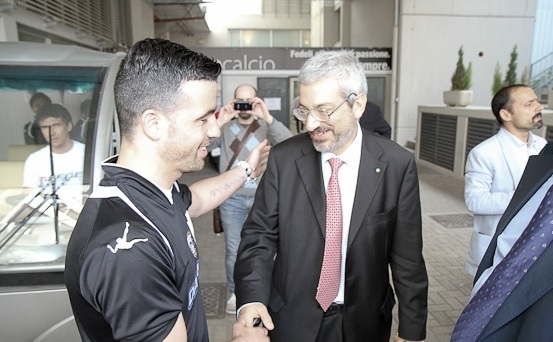
Udinese captain Antonio Di Natale (left) greets Mayor Furio Honsell 
The mayor of Udine, Furio Honsell, is probably used to tortuous complexities given that he was a Professor of mathematics at the Università di Udine until he decided to enter municipal politics in 2008.  He ran successfully as a center-left candidate in the mayoral elections in April of that same year, succeeding the conservative Sergio Cecotti, and has since been the incumbent.

Italian football fans who don't have a keen interest in Italian polity had probably never heard of him until Friday, when Udinese owner Giampaolo Pozzo emphasized Honsell's "bureaucratic miracle" in helping complete the deal that will finally allow, after a ten-year quest, Udinese to begin construction and maintenance work on the Stadio Friuli, which they will now own.

And it was probably not hyperbole on Pozzo's part.  In the absence of any binding legislation, it is a colossally complicated task to ratify construction or the rehabilitation of stadia across Italy.  To Honsell, the challenge of the Italian bureaucracy must have surpassed the one of Lambda Calculus.  Mediating between the city council, eager to exact rent for the stadium, and the club, longing for private ownership of the stadium to boost revenue, must have been an arduous negotiation.

In the late fall of 2011, Honsell communicated how difficult things were, announcing that he was trying to find a solution for Stadio Friuli's refurbishment, and the logistical requirements of concerts in the stadium.  It is precisely these pressures that make club ownership of stadia so difficult in Italy.  City councils want to ensure their own large stake in lucrative activities that go on in the stadium, and by keeping a firm grip on ownership they can do precisely that.  

It is to the mayor's credit that he ensured Udinese become the third club--after Reggiana (not to be confused with Reggina) and Juventus--to own their stadium, granting a huge boost to a club that has been conscientiously profitable on a modest budget for years.

Similar to Juventus's deal with the Turin coucil, Udinese have obtained a land-lease of 99 years.  They will begin working on the stadium after the end of the current season, reducing its capacity by about 16,000 to 25,000 seats.  Crucially, however, they will now be the exclusive, private owners of the stadium, which allows them to capitalize on matchday revenue without having to pay onerous rent to the city council.

The latest "lease" from the city in this case is nominal and symbolic:  a small sum paid at up front, similar to the single euro that Juventus paid the Turin council before they demolished the Stadio Delle Alpi and built their glowing Juventus Stadium in its place.

Udinese won't be demolishing Stadio Friuli, but they will be dramatically changing its look and feel.

"The stadium will be modern, and have facilities open all week to the public," said Pozzo, underlining the importance of having a stadium that is more an experience than merely a venue.

"As for the fans, they’ll have a stadium with covered seating and every comfort from hospitality to restaurants and pre-match entertainment. The people of the city will also have an area of 20,000 square metres that can be used every day”(football-italia).

Perhaps the most telling thing Pozzo said was that the new stadium will undoubtedly boost revenue, which in turn will allow Udinese to hold onto their players longer.  For a club that produces superb talents only to sell them for unmissable profits, this will be a profound change in modus operandi.

It cost Juventus more than 120 million euros to build their stadium.  However, Udinese's project is on a smaller scale and should cost a third of that (with about 26 million euros required at the start of the project), given that this is more of a reconstruction of parts of the Stadio Friuli than a demolition job.

The construction will also remedy the problem of the track that encircles the pitch, quite similarly to how it used to at the Stadio Delle Alpi.  The stands will now be closer to the action.  Most of the changes should be ready by the start of the 2014 season.

Udinese's success should embolden clubs who have had only nascent success (Roma, Catania etc.) with their stadia plans thus far.  While the law that would make private ownership of stadia much easier, Legge Crimi, has been abandoned, Pozzo and Honsell amply demonstrate that a headstrong determination to deliver results can help clubs reach this essential business objective.  Of course, some city councils are easier to deal with than others, but there needs to be a more serious, concerted effort to permit Italian clubs to own their homes.

Juventus and Udinese may be on opposing ends of the spectrum when it comes to many factors--financial, success on the pitch--but the two clubs also have more in common than just the colour of their shirts: a vision and the determination to realize it.


Saturday, 8 December 2012

And here I am, Italian football

Get used to it: Ibrahimovic is presented as a PSG player
It has been a long time since my last post.  The Euro2012 Final was not exactly heartbreaking as it was sobering, and the disappointment of losing a Final disappeared quickly thereafter.   So, I can't attribute a five-month absence to a 4-0 drubbing at the hands of the best team in the world.

No, the reason I had no will to write about Italian football for so long was because of Italian football--not its performances on the field, but more off it.  Two things encapsulate my displeasure.  Let's take a  look.

First, and acutely for me, there was a hideous denouement to the whole Zlatan Ibrahimovic and Thiago Silva affair.  Selling them to PSG was a capitulation to the most vulgar truth of modern football: the nouveau riche are not simply upstarts but ones who can goad the slightly willing into selling half their team overnight.  That is precisely what happened, if not in number then in quality, when Milan sold Silva and Ibrahimovic.

In selling Silva, one of the best defenders in the world, Milan pioneered a market manoeuver of shocking duplicity, which stands alone in its callousness towards fans.  When PSG got serious about Silva and were tantalizingly close to getting him, in stepped, predictably, Silvio Berlusconi for the colpo di scena, sparing fans and Silva alike from the indignity of selling their team's foundation to a team that flashed a little cash.  I am being reductive here, as there was more to it than Berlusconi, but it was he who headlined the rescue.  

Silva renewed his contract, and Milan fans could breathe a sigh of relief at least for the 2012-13 season.  However, a few weeks later, Silva was sold remorselessly to PSG.  It was cruel even by Milan's recent standards.  The fans least suspected it because a contract renewal has been a time-honoured gesture of the player and the club to continue their relationship at least for the subsequent year.  But Milan relinquished tradition a long time ago. 

And then there was Ibrahimovic who was hastily and gracelessly shown the exit as part of the package deal. The Swede is not generally known for his retreating disposition, but he has every right to despise the suits at Milan, and by all accounts he does (he and Galliani don't talk now).  Milan didn't spare him any indignity.  They wanted him gone if Silva was gone, which is not a very edifying approach to dealing with a player who had allowed Milan to stand on his shoulders and grab a Scudetto in the two seasons he was there.   

The protest and response in Italy was surprisingly muted, leading to speculation that Galliani had perhaps promised something to the hard core of the Milan contingent, the Curva Sud.  This cadre has always been at the forefront of Milan mirth, madness, and melancholy over the years, but their protests were tame by their standards and they have, to their credit, supported the team through a disastrous start to the season.  Lest we forget, Milan's season is now recovering, unlike my faith in the men leading my club.   We are at the whim of Berlusconi until he decides to sell. 

Andrea Pirlo and Claudio Marchisio
Secondly, and more succinctly, Legge Crimi, the stadium law that I have written extensively about has still not been ratified. In its jarring absence, there have been some promises by Roma and Inter for a new stadium, but those projects are slated for 2016.  The toxicity of the legislative bodies, local councils, and politicians in Italy is staggering. Vested interests have once again trumped broader utility.  The law that would allow teams to refurbish their dilapidated homes is still on standby, and so are the potential revenues that could be realized by these clubs on matchdays.

This event and non-event are symptomatic of what is totally rotten in Italy.  The suits lie and dither, and Italian football suffers.  But that is why I'm back.  I have to write about Italian football even when it is lurching from one crisis to the next.  I have been for a while now, so why not continue?  At the very least, the textual trace will give the chaos and hopelessness some form and geometry.  

And of course, there are some plus points.  On the field, Italian football is showing signs of hale. In Europe, five teams are still alive.  Juventus emphatically announced their return to the big time by flattening the reigning European Champions Chelsea 3-0, a victory that allowed the spectator to anatomize how effective Juventus really are.  A midfield of Claudio Marchisio, Arturo Vidal and Andrea Pirlo could even play behind invisible men and still make inroads into the opposition half at will.  Speaking of invisibility, even in Antonio Conte's conspicuous absence (he is serving a harsh ban), Juventus are still at the summit of Serie A (though they have lost to Inter and Milan this season), and have just finished top of their Champions League group.

Lazio, Napoli and Fiorentina have been impressive as have been Inter.  Milan started the season poorly, but Stephan El Sharaawy, Riccardo Montolivo and at times Bojan have shown that Milan can predicate a revival of fortune and spirit on these younger players (Montolivo at 27 being the geriatric among the three). There is hope because Italian football, as I have written about countless times, as a philosophy, as a way of playing, is still powerful and effective.  Italy just went to the Final of Euro2012, humiliating England and soundly beating Germany on the way, and this year's football in Serie A has been compelling, even exciting.

Considering the cynical bureaucrats running the game are disinclined to bring about real change, the coaches and players deserve immense credit for their effort.

Forza Italia!

Wednesday, 9 May 2012

Vindication: Juventus Back On Top in Italy

Top...Chiellini leads the celebrations for Juventus
After Milan's tumultuous 4-2 loss to Inter, and Juventus's 2-0 win against Cagliari, I sent a quick email to a close Juventino friend of mine from Italy, congratulating him on a well-deserved Scudetto.  His response was emphatic, eloquent: "End of nightmare!!!"

As the depravity of Calciopoli assailed Serie A fans six years ago, as the Bianconeri's long-faithful--and long-unfaithful when considering Luciano Moggi's instrumental role in the match-fixing--exited tearfully, defiantly, disgraced, and broken, one got the feeling that the club's very identity was at stake.

The last six years have indeed been a sort of nightmare for Juventus, relieved only by a motivational sense of indignation and injustice--however unfounded.  The overwhelming feeling that Juventus were punished too severely has sustained the club through a time that has seen their two main rivals, Inter and Milan, win Scudetti and European Cups.  Most gallingly, in the case of Inter, Juventus's most despised rivals, domestic superiority between 2007 and 2009 owed a lot to Zlatan Ibrahimovic, a former Juventus player brought to the club from Ajax by Moggi in 2004, but one who left to Inter when Juventus were relegated to Serie B after the scandal.

Now, finally, there is some redemption.  For all of their past faults, Juventus are pointing the way forward for the whole of Italian football.  The club's first Scudetto since 2003 (or 2006 depending on your perspective) comes in a season at the start of which they unveiled their very own stadium, a state-of-the-art facility that has consigned the cavernous Stadio delle Alpi to a distant memory.  Juventus are the only club in Serie A, and one of two in Italy (Reggiana being the other one) to own their own stadium.  Admittedly, business sense does not always equate to on-pitch success, but Juventus's season has been a sort of homage to their fiscal foresight.  It is almost as if their success on the field is an inauguration of a modern era:  Juventus are not only winning, but they have laid the commercial and financial groundwork to keep on winning.

"What they have done in Turin cannot be repeated in Milan," said Milan vice-president Adriano Galliani this season. "We cannot build a stadium here, but for now we can renovate the San Siro."

Not what Milan fans wanted to hear.  The San Siro is becoming a hollow, sun-deprived anachronism.  A part of its turf is denied regular light due to a tier built during Italia'90, and the results of that architectural blunder have been embarrassing for the club, as both Arsenal and Barcelona complained very publicly about the patchy field.

Encapsulated in the state of each of Milan's and Juventus's stadium is the narrative of this season.  While Juventus boss Antonio Conte did revert to the conspiratorial this year, pathetically blaming the referees for being afraid to give Juventus decisions, he pioneered a path forward for a side that had finished seventh the last two seasons.

"Remember," said Conte in the wake of any mishap or slip during the season, "we were seventh only last year."

When you consider how marginalized Juventus have been from the title race since 2007, Conte has done an incredible job to steer them to a Scudetto.  Milan, on the other hand, capitulated to a languor, a post-Barcelona arrest that came as a result of an exhausting Champions League quarter-final.  It was a hangover that cost them everything.  With a month to go in the Scudetto race Milan were ahead of Juventus with a much easier run-in.  However, a loss to Fiorentina, a draw to Bologna, and a humiliating 4-2 loss to Inter on Sunday buried their challenge in a heap of stupidly concocted excuses, old ideas, and old players.

"That one incident cost us," maintained Milan coach Massimiliano Allegri often this season.  The "one incident" was the Sulley Ali Muntari goal against Juventus that was shockingly disallowed.  That game ended 1-1 and at the time Milan had a point to complain.  But since that incident Milan have been fundamentally incompetent.  They simply didn't deserve the title.  Their record against the 'big' teams this season was atrocious.

True, they were playing two competitions, while Juventus were essentially playing one.  Also true, they had the most injuries of any team in the league, and Juventus the least.  However, that is precisely my point: Milan's loss of the Scudetto this year is a clamorous defeat of their system, their philosophy.

Expectant...Zlatan Ibrahimovic
We heard many things about the vaunted Milanlab, but the injuries kept piling up.  "It cannot go on like this," Zlatan Ibrahimovic said after Thiago Silva, foolishly risked in the Coppa Italia by Allegri, was ruled out for more than a month. "Something has to be done about the injuries."

We heard much of the commitment of the senatori, but they looked jaded, glaringly past their sell-by date.  For one telling example, Clarence Seedorf played with a disgusting sense of entitlement, petulantly reacting to being substituted late in the season in the game against Bologna.  Seedorf's attitude was only so bold because the club has allowed old players generous contracts rather than showing them the door.  It may sound callous, but it is the only way to run a football club--and keep key players happy.

"I was told we were making a Grande Milan," said the begrudging voice of the club, Ibrahimovic. "Let's see if they are still interested in doing that."

Ibrahimovic heaved sighs throughout the season, but he did his part and then some: he has already scored 28 league goals, and he was ubiquitous against Arsenal in the Champions League second-round first-leg.  But playing behind him throughout the season were players who couldn't even provide service, the partnership, the collegial inspiration that he wanted and deserved.  Antonio Cassano did only occasionally because he was out with a heart problem for a long part of the season, while Kevin-Prince Boateng was injured far too often.

Ibra must be tired.  He must be tired of an old system with old players. It is not only that Arturo Vidal lines up for Juventus in midfield while Massimo Ambrosini does so for Milan; it is not only that Juventus won the key games of the season; it is not only that Juventus have stayed unbeaten thus far; and it is not only that Milan suffered untimely injuries.  Juventus's win was also a vindication of their modernity, their rejection of complacency, their good work in the transfer market.

When asked if Milan would be signing top players this summer, Galliani replied idiotically, "we already have two in Ibrahimovic and Thiago Silva."

The former is being pursued by Real Madrid, the latter by Barcelona.  Both will probably stay this year, but both will want guarantees of a competitive team.

Milan's attitude is even more bizarre when you consider that they are still, despite Juventus's new stadium, the team that earns the most in revenue in Italy.  However, it is their failure to adapt to the changing landscape, their failure to bring in players who can complement the likes of Ibra and Thiago Silva that may prove disastrous for seasons to come.

Juventus have the momentum now, and with Champions League revenue, they will buy key players.  The club from Turin, maligned in recent years, has done it the right way, and they are at the top of Italian football again.  And it is up to Milan to prevent the Bianconeri laying down a hegemony over the league for seasons to come.


Sunday, 4 March 2012

Milan's and Ibra's Timely Triumph

Milan's Zlatan Ibrahimović roars at and through the competition
Palermo 0-4 Milan.  It was the kind of game that you wouldn't really expect after a week of acrimony and apologies that reminded us how fragile the diplomatic equilibrium is in Serie A between Italy's two biggest clubs, Juventus and Milan.

Sulley Ali Muntari's goal that was not given--sorry, that was taken away after being given--last weekend against Juventus urged Milan's no. 2 Adriano Galliani to leave the San Siro because of high blood pressure.  Not before, however, him making sure that his precarious systolic and diastolic balance was upset completely.

"Look what happens when you cry," he is reported to have said to Juventus coach Antonio Conte in the tunnel. "It clearly works."

"What a pulpit--you people are the mafia of football," was Conte's response.

Galliani was referring to Juventus's sustained self-victimization before the game last weekend, which everyone is guilty of is in Serie A at one point or the other. Conte was referring to the perceived influence Milan have had in Italian football, the kind of influence that Juventus have also had, and the kind that Juventus have exerted shamefully in the past (Calciopoli and all that).  The notorious, erstwhile duopoly of Italian football arguing over injustices is not a very edifying moment, and not a moment that the Catanias and the Chievos should have any time for.

Comically, the 1-1 draw last weekend, during which Milan outplayed Juventus for most of the time, sobered Conte.  After realizing how undeserved the draw was (even considering Alessandro Matri's goal that was perhaps disallowed correctly), the Juventus coach spoke of a need for sensibility all around when talking about officiating.  It was a bit like being lectured on safe environmental practices by a suit at British Petroleum.

However, mainly for the better of public appearances, Galliani and Juventus president Andrea Agnelli made up over the phone.

Against such a backdrop, Milan coach Massimiliano Allegri deemed the trip to Palermo yesterday as being critical to the season.  It was a game that would show what Milan are made of.  The sense of injustice in the Milan camp was feverish--and poor Palermo were incinerated.

I haven't seen Milan play that kind of football since 2005.  Palermo were marginalized to the point of being spectators.  The Milan defence and midfield got to every ball first, and Robinho and Zlatan Ibrahimović did the rest.  Ibra's hat-trick in the space of fourteen devastating minutes underlined Milan's rage and the Swede's centrality to this Rossoneri side.  Really, it seems pathological to deny how vital Ibra is to this team, and there are many out there who think he is a liability due to his disciplinary problems.  But surely he more than makes up for it, and perhaps we can see the time he spends suspended as well-deserved rest.

Returning after serving a harsh three-match ban, Ibrahimović  went to work, dismantling Palermo.  The hat-trick came from both feet, and was a display of precision and understated power.  He was unplayable, unstoppable, and unforgiving.

"I still think about that Juventus game," he said after the match.  Clearly.  Like a Bollywood hero driven by revenge and a soundtrack, Ibra smashed his way through Palermo, flaying pink flamingos at the Renzo Barbera, which is not the happiest hunting ground for Milan.

Chievo celebrate as Juventus deflate
Robinho was exquisite too, providing assists to Ibra, but it was the giant's night.  He is now tied with Antonio Di Natale at the top of the scoring table on 18 goals.  And he shows no signs of stopping.

Of course, sometimes perceived injustice can be the best spur.  There is no conspiracy against anyone, and I say that even after the lurid scandal of 2006.  However, what Conte has lost in the last week is his ability to moralize, and his team have lost the ability to win.

 Almost three hours after Milan's proclamations of power, Juventus dropped two valuable points against Chievo in a 1-1 draw. At home.  They have picked up just seven points out of the last fifteen on offer.  And they have all sorts of tough games ahead, while Milan have a much easier schedule.  The Bianconeri are undefeated this season, but they have drawn 12 games, one less than the amount they have won.

"People forget where we came from," said Conte after the draw yesterday.  "Last summer there was talk of us ending up sixth, and now look where we are."

That won't cut it with the jeering Juventus fans, who whistled the team after the game yesterday.  As for  Milan fans, they can thank Boukary Dramè for the late drama yesterday.  At 1-0 Juventus looked like they would see a win through to the end, but then Dramè shot past Gianluigi Buffon, and Juventus defender Leonardo Bonucci did the rest by deflecting the ball in the goal.

Milan are now three points ahead of Juventus, who have a game in hand against Bologna.  After a week of talking about officials and phantom goals, it was heartening to be reminded that the players can still boss this Scudetto showdown.  And there is no bigger boss than Ibra.

Tuesday, 3 January 2012

Calcio: 2011 and 2012

Full-time poseur: Silvio Berlusconi
I know this is late. I have to confess that I hate the Best or Worst of a Year list, so I won't give you a perfunctory revision of notable events this year in Italian football.  Your level of engagement with football must be profound enough to recall personal moments of exhilaration anyway.

Of course, games like Barcelona's dismemberment of Manchester United in the Champions League Final are unforgettable for many, including neutrals, but I actually forgot about the game within two weeks.  It confirmed that Barcelona need only to put in a fluent performance to get the eager fingers of fawning journalists working in service of Pep Guardiola's men.  Yawn.  Great team, no doubt; great enough to even rival--perhaps, even surpass--that Milan team of Arrigo Sacchi and later Fabio Capello. As a Milan fan, I say that grudgingly of course. 

What stuck out for me in 2011 were trends.  Some are heartening, others distressing.  Since this is an unapologetically Italian football space, I am more concerned with how these trends can and will impact the competitiveness of Italian football in the future.  That and almost solely that is always my chief concern when an impossibly rich Arab takes over a club in France or England, or when UEFA president Michel Platini triumphantly claims that with the introduction of Financial Fair Play rules fiscal sanity is imminent. 

The pathologies of football--greed, delusion to name just two--have been plainly evident for a while.  You can add schizophrenia to that list also.   On the one hand, you have bureaucrats like Platini about to purge the game of excess, and on the other Paris-Saint Germain's Qatari owners have now added themselves to the list of foreign owners seemingly committed on immoderate investment despite FFP.  Manchester City's ludicrous naming rights deal for their stadium is an obvious ruse that illuminates the modus operandi of football's rich.  It remains to be seen how exacting FFP's stipulation of agreeing commercial deals at market value really is.  

Not for nothing has Arsenal manager Arsene Wenger become more cynical than usual.  Unlike his coiffure, the Frenchman seems perennially ruffled about something, but his wariness of all the talk about probity and health in football is justified.  

Where does this leave Italy? Platini and others have maintained that the FFP is being introduced after the complaints of wealthy owners like Silvio Berlusconi and Massimo Moratti.  There certainly appears to be, then, two classes of rich people in football currently.  The ownership of Manchester City, PSG, and to a lesser, but still considerable, extent Chelsea, are willing to spend for success.  Moratti and Berlusconi, however, do not seem willing to test the limits of FFP.

"The money in football is crazy," said Berlusconi recently. "Don't forget that PSG have Qatari investment behind them now.  I have made generous, perhaps too generous, investment in Milan for many years."

Even his disgraceful exit from politics this year seems not to have diminished his posturing.  FFP is the perfect alibi for Berlusconi, who has spent considerably less on players over the years because he simply does not want to any longer.  

Pioneers: Reggiana (maroon shirts) at the Stadio Giglio
The folks at Inter have been much more candid about their plans.  CEO Enresto Paolillo has come out and said clearly that Inter's strategy has changed, and they will sign much younger players.  Their market plans cannot get going unless they sell big, and Wesley Sneijder is the one player who can bring in a lot of money, so he may indeed be sacrificed.

In a country where methods of merchandising, sponsorship, and, most importantly, private ownership of stadia are embarrassingly outdated or non-existent, taking away the ability of a patron to intervene when needed seems to be a crushing blow to its football.  But there are mitigating factors.

For one, Juventus unveiled their sparkling stadium, Juventus Arena, as proof that even in Italy, bureaucracy and vested interests can be overcome.  The Bianconeri deserve all the plaudits for their feat.  Their stadium will reportedly take their income to fifteen percent of their revenue, providing them a far more balanced portfolio.   Serie B side Reggiana--distinct from Reggina--are the only other club in Italy to own their stadium, the Stadio Giglio.

There have been encouraging efforts towards private ownership of stadia, but they remain incipient, paralyzed by a toxic bureaucracy.  The law known as Legge Crimi, which I wrote about in 2011, still remains dismayingly far from fruition. Despite the delay, clubs are approaching city councils in a hope to refurbish dilapidated stadia, and leading this initiative are trailblazers such as Napoli president Aurelio De Laurentiis and Roma president Thomas DiBenedetto.

Milan have not pursued the idea of owning an arena.  Vice-president Galliani asserted that what Juventus have done in Turin is "impossible" to do in Milan.  Instead, they have struck a lucrative deal with the largest oil company in Albania, Taci Oil, whose owner, Renzart Taci, is a committed Milan fan.  It is now common to see Taci digital billboards at San Siro.

There is some hope, then.  It was difficult to imagine that Italian clubs, long at the forefront of Europe, would surrender so easily to the English, Spanish, and the Germans; so, on the field, Italian clubs have enjoyed an outstanding run of results in Europe, a rare sight made even rarer in recent years by the Europa League, which is widely seen as a contemptible, bloated cousin of the Champions League.

However, both Udinese and Lazio are through to the next phase of the competition, and that achievement coupled with Napoli's ability to squeeze out of a Champions League group containing the heavyweights of Bayern Munich, Villarreal, and Manchester City makes Serie A serious again.  The Partenopei face Chelsea in the round of 16, while Milan take on Arsenal, and Inter Marseille, ties that have all been deemed easier-than-what-could-have-been.

While the progress of Milan and Inter in the Champions League hasn't startled anyone, Napoli and Udinese have humbled even the most dedicated Serie A critics.  Udinese's 2-0 win over Atletico Madrid at the Friuli effectively sealed their qualification, and it came despite no Antonio Di Natale, who was rested.  Even after selling Gokhan Inler and Alexis Sanchez, Udinese have not only remained competitive, but have perhaps enhanced their reputation as a club that has a vigorous scouting system and monumental self-belief.

Against Celtic, at Celtic Park, hardly the place for a stroll, Udinese coach Francesco Guidolin rested almost all his players and came home with a 1-1 draw.

"We must interpret the competition this way," said Guidolin of the Europa League, after he was criticized for his apparent temerity.  "Otherwise our youth won't get a chance."

Legends: Roberto Baggio and Demetrio Albertini
Napoli, who admittedly operate on a budget superior to that of Udinese, dismantled Manchester City with the same swagger.  It is the Italian clubs' renewed trust in the system, as a purely footballing approach, that is sparking both a sort of revivalism--dispelling notions that the way Italian clubs play is not 'modern enough'--and a movement that is inaugurating and adopting long-needed ideas.

Former Italian football legends, Demetrio Albertini, who is the vice-president of the FIGC, and Roberto Baggio, who oversees the technical sector for the FIGC, have identified specific areas of improvement, chief among which is the way the youth is handled in Italy.

"There are too many foreigners," said Albertini earlier in 2011.  "Our youngsters don't get chances because clubs rely too much on foreigners."

Seems like a reductive and xenophobic statement, but it has an element of truth.  Italian clubs simply have not been nurturing talent, talent that is becoming increasingly diffident because of the lack of opportunities.  Hopefully, Albertini works with clubs to make the youth systems more appealing for them; indeed, with the FFP, the youth systems of clubs could become even more crucial.

On the international scene, the Azzurri under Cesare Prandelli look ardent enough to register on Euro2012.  The group containing Ireland, Croatia, and Spain looks difficult, but I can see in the team, even if in glimpses, the same confidence that Marcello Lippi had instilled in his team before the 2006 World Cup triumph.  Even Antonio Cassano's illness and Giuseppe Rossi's injury have done little to quell expectations of players and fans.

Prandelli must find the competitiveness of Serie A gratifying.  Milan and Juventus sit level on points, with Lazio, Udinese, and Inter all in pursuit of top-spot.  Napoli and Roma will have some sort of say on the Scudetto-- if not directly, then indirectly in the form of taking points off the leading pack.

Italian football may be battered, but it is by no means moribund.  As an expression of football, it still holds some power over Europe, and 2012 may be a rewarding year for its school and philosophy.  Away from the bureaucratic battles, these battles and trends are heartening.

Happy New Year!

Saturday, 1 October 2011

Serie A Clubs Move Ahead Despite No Legge Crimi

Big plans: Aurelio De Laurentiis
I recently wrote about how the passage of Legge Crimi would dramatically change the modus operandi of Italian clubs when it came to working with a more balanced financial portfolio.  However, as was and is infuriatingly predictable, there seems to be absolutely no movement in passing the law through the branches of the Italian parliament.  Yet, a few clubs have announced their intention to renovate or rebuild a stadium.  It seems in the absence of any forthcoming legal imperative, clubs have shown some welcomed initiative, and the success of their initiative has depended on the extent to which city councils have been willing to negotiate.  For example, in the case of Juventus, the negotiations were swift, and the Turin city council sold the Stadio Delle Alpi to the club.  Of course, given all the well-known problems of the Stadio Delle Alpi--discussed in part here--Juventus elected to level the stadium to build a new home.

While Juventus still lead the way with their privately owned Juventus Arena, replete with commercial and merchandising opportunities, other clubs strive to follow to some degree the Bianconeri's model.  Four clubs are in some stage of improving their habitat.


Napoli: President Aurelio De Laurentiis has exhibited the most bravado.  Before his club's trip to England to take on Manchester City in this season's Champions League, he disparaged his opponents by describing them as unconscientious spendthrifts.  He also called on Michel Platini to be serious in applying the Financial Fair Play Rules.  When he is not antagonizing, De Laurentiis is diligently working to make Napoli a force--on the field and financially.

He has said that he will not bring down the Stadio San Paolo because of its history, but rather improve its existing state, and commercialize the surrounding areas.  He plans on revitalizing the Fuorigrotta area, the site of the San Paolo, during the upcoming summer.  This smaller initiative will contribute to De Laurentiis's broader plan, which includes, as Paolo Bandini tell us, "increasing the training pitches to seven, [and] the construction of living quarter for youngsters, as well as a school building where they can get help with their studies."

Palermo: It is always wise to take what Palermo owner Maurizio Zamparini says with sacks and sacks of salt.  However, even in his capricious universe, he seems serious about creating a brand new stadium for Palermo.  During September of this year, he said that soon Palermo will unveil plans for a new 35,000 seat stadium.  Of course, Zamparini has attempted to build a stadium during his ownership of Venezia as well but was thwarted by the typical bureaucratic problems.  This one will be interesting to follow.

Still trying: Thomas DiBenedetto
Roma: President Thomas DiBenedetto arrived at the club with admirable enthusiasm, announcing that building a new stadium would be the priority.  He had probably not accounted for the intransigence of Rome's city council.  Since those claims, Roma have had to put those aspirations on hold until further notice, and they will have to be content with just trying to improve the matchday experience, which means increased commercial activity around the Stadio Olimpico.  The track between the spectators and the stadium absolutely has to go.

Not the unqualified revolution for which many were hoping, but it remains to be seen whether Roma will get some breathing room in the future to realize DiBenedetto's initial hope of a new stadium.  If the temporary solution turns out to be the one that endures, it will be disappointing.

There were murmurs, however, that Roma could have a new stadium in three or four years.  It all depends on the cooperation of the city council.

Udinese: It is unclear whether president Giampaolo Pozzo has definitive plans to build a new stadium.  Some say that there are improvements planned to the current stadium (with reduced capacity making way for better viewing).  What is ambiguous is whether Udinese plan to own the Friuli (buying it from the city council), or if they plan only to work under the existing ownership.


So the news is mixed.  It appears stubborn city councils are still hindering clubs like Roma, but clubs like Napoli, buoyed also by their exploits in Europe this season, are planning big things.  Meanwhile, Milan vice-president Adriano Gallian refuses to cheer up.  He maintains that the feat Juventus have managed in building a new stadium cannot be achieved in Milan.  "The most we can do," he maintains, "is improve the San Siro and make it suitable to host the Champions League Final."  Not the ideal news for Milan fans who were hoping to rival Juventus with their own home.

Nevertheless, as clubs wait for Legge Crimi, which may be far off in the future, a lot of work remains to be done, but clubs are taking some steps forward.

Friday, 1 July 2011

Serie A's Schizophrenic Summer

Lugubrious: Milan's Adriano Galliani
Depending on whom you ask, and when you ask, Serie A's purchasing power is either irretrievably curtailed, or on the verge of steadily increasing.  If you ask Milan vice-president Adriano Galliani in the aftermath of another TV rights meeting, you could be forgiven for thinking that Italian football is on the brink of financial ruin brought about by a chronic unwillingness of clubs to pull in the same direction.  Yet, if you ask the Juventus management, still beaming from a huge cash injection from Exor and their new, privately owned stadium, the Bianconeri are pointing the way forward for Italian football (incidentally, despite the widespread enthusiasm, the money from Exor comes with strings attached, as this article in La Gazzetta dello Sport explains).

We should look at both positions with skepticism.  Galliani's incessant claim that impending or existing legislation domestically (a more equitable TV rights distribution mechanism, high tax rates) and abroad (Financial Fair Play rules) will relegate Italian football to an emasculated middle class of European football is not simply alarmist.  However, his complaint should always be contextualized in the years and years of crippling financial mismanagement of Serie A--mismanagement that the likes of Milan, Juventus, and Inter were complicit in.

During the 2000s, Juventus, Milan and Inter were the most egregious examples of clubs who refused to operate on a level playing field.  Since no Italian club owned its own stadium, TV rights became the main polarizing force.  The bigger clubs of Serie A each negotiated obscenely lucrative viewing rights for their games, while those in the lower reaches of the table were left to drudge on.  When the minnows did complain, perennially and vehemently, they were treated as upstarts who had to be placated for the more important show to go on.

And so, we would face delays to the start of the season, until the bigger clubs of Serie A would deign to let some of the money trickle down to those beneath them in Serie A and Serie B. Of course, Galliani used to lament the state of Italian football then too, but not as stridently as now.  After all, Milan were one of the biggest beneficiaries of an innately exclusive system.  And when Galliani's conscience would slightly prod and prick, he would sanctimoniously say that clubs need to lower their costs.  Francesco Totti is hardly the shining example of eloquence, but he was able to brilliantly characterize Galliani's infuriating diplomacy by once tartly remarking, "Galliani complains about costs, [and] then goes and signs Rivaldo."

In the near future, I plan on providing a comprehensive account of how TV rights have developed and influenced Italian football; here, I am more concerned with how the transfer market in Italy continues to confuse.  On the one hand, you have a person like Galliani, who always reminds us of the imminent decline of Italian football, during and after which Italian clubs will ruefully recall days when they used to rub shoulders with the European elite on and off the pitch.  On the other, you have a club like Juventus, who have built a stadium and are after Atletico Madrid's Sergio Aguero, one of the hottest properties on the transfer market, whose worth is in excess of 30 million euros.  All signs suggest that they may get their man.  What is the true state of Italian football, then?

High profile: Sergio Aguero
That Milan, Juventus and Inter are finding it harder and harder to compete with the top clubs of Spain and England is becoming excruciatingly clear.  However, there is a dissonance between that sobering reality and the demands of the fans.  While some profoundly fear what the Financial Fair Play rules will do to Italian football (with no benefactors able to pump cash in the gap between Italian clubs and others will grow), others still believe that the rules are nothing but bluster from UEFA, who are in thrall of the European elite clubs, and would never seriously disbar any club with clout from European competition.  The latter contingent expect big arrivals this summer.

UEFA's commitment is hard to gauge currently, and there may be some truth to what the skeptics are saying. However, more important is for Serie A to consider how to get back to some form of level terms with the bigger clubs of Europe.  The political intransigence (city councils will just not let go of stadia) in the country means that private ownership of stadia is not a forthcoming reality.  Moreover, while Juventus may be boasting about their stadium (and it is revolutionary and commendable, as I recently wrote), it remains to be seen how much matchday revenue they will actually generate from an audience that has been shying away from stadia due to racism and violence.  And even if fans do flock to the new stadium, there is no guarantee that gate receipts will fetch the exorbitant amounts that clubs in the Premiership enjoy.

It is all an inscrutable and frustrating mess.  Recently, I wrote an article about Milan's need to buy a big name this summer, but I attempted to adjust my enthusiasm to the crushing realities of European football. It isn't fun, but fans may also have to modulate their expectations of what the big clubs in Serie A can do.  Unfortunately, it becomes very difficult when the press mentions names like Aguero, Carlos Tevez, and Fabregas routinely.

Not for the first time, and not for the last, Serie A appears to be enduring, or perhaps performing another schizophrenic summer.  The transfer market in Italy has always been gripping theater, and this latest confusion only enhances the intrigue.  Recall that last summer, after publicly decrying their poverty, Milan raised the profile of the league by bringing in Zlatan Ibrahimovic and Robinho.

Pulling off something similar this summer may be more difficult.  Or not. You can never tell with Italian football.

Tuesday, 31 May 2011

The Progressive Old Lady

A view to forget: Stadio Delle Alpi
Even on television, the Stadio Delle Alpi of Turin felt like a stadium to which teams were sent to play as punishment.  A running track encircled the field, obscuring the view of the crowd by adding unnecessary distance, and the acoustics of the cheering crowd sounded like a riot underwater.  The grotesque venue was an architectural conundrum not from any post-modern resistance to defined geometry, but because it left doubt as to whether any planning went into it all.

Built in 1990 for the World Cup, the Stadio Delle Alpi failed to attract a sizable crowd on a consistent basis.  The stadium could hold about 68,000 spectators, but average attendances for seasons were well below that.  The shape of the stadium was certainly a major reason, as were the facts that it was located on the outskirts of the city and that many Juventus fans do not live in Turin (however, it should be noted, even attendances for Torino's games were low).

Juventus' coruscating 3-1 victory over Real Madrid in the Champions League semi-final in 2003 was witnessed by an almost capacity crowd, and that remains one of the most memorable nights for the club at the Stadio Delle Alpi.  Yet, it was depressing to watch such a liberating performance play itself out in an oppressive cavern.

In what will come as good and perhaps old news to some of you, the stadium has been demolished for over two years now, and Juventus, who have been playing at the Stadio Olimpico in Turin, are expected to battle in their new stadium next season.

Juventus vs Real Madrid at the Stadio Delle Alpi
The new stadium is called Juventus Arena for now, and will hold about 40,000 people.  It reportedly cost about 120 million euros to build.  Though built on the same plot of land as the Stadio Delle Alpi, it will not suffer from the architectural shortcomings of its predecessor.  The seating, for example, is much closer to the action.  In addition to these improvements, the stadium will also have eight restaurants, four-thousand parking spaces, and an area commemorating the thirty-nine Juventus fans who died at Heysel.  The plans for the stadium were announced in November 2008, and the construction took two years to complete.

While the stadium itself is not impressive when you compare it to where most clubs in the Bundesliga and the Premier League play, in the context of Italian football it is revolutionary.

Juventus are the only club in Serie A to have their own stadium.  Clubs like Roma and Milan have talked about one, but there are no firm plans for construction.  The private ownership of a stadium should boost Juventus' revenues, for they do not have to pay an annual rent to the city council.  The bigger Italian clubs have traditionally relied on TV rights and benefactors to stay competitive in Europe.  However, with the Financial Fair Play rules about to take effect, the benefactor factor may dissipate (it remains to be seen how stringently these rules will be enforced), and Juventus seem to be the most prepared team in Serie A for that possibility.  They now boast a more diverse financial portfolio, which bolsters chances of competing with the bigger clubs of Europe.

Of course, it remains to be seen exactly how much of a success the new stadium will prove to be financially or in terms of popularity with the fans.  Yet, surprisingly, there is relatively little discussion about its potential benefits to Juventus. Juventus' main rivals, Inter and Milan, have still not laid out concrete plans to build a new stadium.

The official website shows work on the new stadium
Milan vice-president Adriano Galliani talked about problems with the San Siro as early as October 2005, claiming that Milan directors had "different ideas" about the stadium than their counterparts at Inter, with whom they share the stadium.  He also admitted that it was imperative that "new stadia be built" in the country in general, due to their dilapidated state (stadia have not been extensively renovated since the 1990 World Cup).

Not all of it is cynicism.  Galliani has been deploring the financial advantages that foreign clubs enjoy for a few years now, but it is Juventus who have taken an effective approach in addressing the growing disparity.  In the post-Moggipoli era, Juventus, whether led by former president Giovanni Cobolli Gigli or the current incumbent Andrea Agnelli, seemed to have done little right on the market, and their results on the field have resulted in anguish for their fans.  However, the club, nicknamed La Vecchia Signora (The Old Lady), has shown a penchant for the modern by pioneering with a new stadium.

The late Juventus and FIAT head Umberto Agnelli once said that the Bianconeri "have followed the evolution of the nation," referring in part to how inextricably linked the team became to FIAT, a symbol and register of the Italian economy for decades.  Now, it seems Juventus is also creating a revolution in the nation.

Thursday, 12 May 2011

Palermo's Chance to Redeem 1979

Pink on pink: Gazzetta beams Palermo
Palermo coach Delio Rossi was not exaggerating when he said earlier this week that Tuesday's Coppa Italia match could be a "historic day for Palermo and Sicily."  Palermo's 4-3 aggregate Coppa Italia semi-final win over Milan means that the Rosanero will play the final of the competition after thirty-two years.  For the newly-crowned Italian champions, reaching the final would have been di rigueur; for Palermo, as evidenced by their unalloyed joy at the final whistle on Tuesday, reaching the final means the chance to banish an oppressive historical burden.

Palermo lost both of the Coppa Italia finals they appeared in during the 1970s--the first to Bologna on penalties in 1974, and the second to Juventus in extra-time in 1979.  Despite playing in Serie B during the 1970s, Palermo, owned by Renzo Barbera at the time, enjoyed a successful decade.  However, those two defeats still remain as bitter memories.

The loss in 1979 is particularly painful given how close Palermo came to upsetting a Juventus side that boasted the likes of Dino Zoff, Claudio Gentile, Antonio Cabrini, and Roberto Bettega.  On June 20th, 1979, coach Giovanni Trapattoni, who had already won two Scudetti with Juventus by then, led his Bianconeri out at the San Paolo.  Within a minute, he saw his side fall a goal behind.

Vito Chimenti (the uncle of Antonio Chimenti, who played most recently for Juventus as reserve goalkeeper) surged into the box and sped past Zoff before putting the ball into an empty net.  It was a dream start for a club that was still playing its football in Serie B, and for Chimenti, whose sparse hair belied an age of just twenty-five years and bore testament to the rigours of Italian football away from the prominence of Serie A and even Serie B.  Chimenti had played his football primarily in Serie C for Lecco, Salernitana, and Matera before coming to Palermo in 1977.

Despite Palermo's euphoric start, Juventus responded with a goal from central defender Sergio Brio in the first half, and midfielder Franco Causio in extra-time.  Palermo had managed to push Juventus well beyond ninety-minutes, but ultimately they did not have enough to pull off an upset.

Vito Chimenti
In the decades following that defeat, Palermo have reached the latter stage of the Coppa Italia only once, and that was during the 1995-6 season, when they were eliminated at the quarter-final stage.  Ever since their return to Serie A in 2004, which took twenty-one years, Palermo have consolidated themselves as the challenge from Sicily, especially considering Messina are playing their football in Serie D because of financial troubles, and Catania have finished well below Palermo in recent seasons.  Palermo have even managed to play in Europe, and they are guaranteed to again next season.  All these achievements have come partly because of and partly despite an impetuous owner in Maurizio Zamparini.

Zamparini has often inveighed against the lopsided balance of power in Serie A.  Winning the Coppa Italia against Inter on May 29th will be especially gratifying for him not only because it would redress the pain of thirty-two years ago, but also because it would mean victory over one of the establishment.

They may not be up against Juventus, but beating Milan and Inter en route to Coppa Italia glory would go a long way to atone for 1979.