Showing posts with label Roma. Show all posts

Tuesday, 17 April 2018

Udinese's and Italy's Stefano Fiore

Inzaghi and Fiore (right) celebrate the goal against Belgium
Stefano Fiore celebrates his 43rd birthday today. Here is a look back at his career.

At Euro2000, the usual debate of 'which superstar should play' had followed the Italian national team into the tournament. Was it to be Francesco Totti or Alessandro Del Piero?  After the group stage, it seemed coach Dino Zoff preferred a twenty-three-year-old Totti to Del Piero.  The Roma man started the first two victorious games for Italy against Turkey and Belgium, scoring in the latter; Juventus's Del Piero started the last meaningless one against Sweden, in which he nonetheless scored a blistering winner in the 88th minute.

The debate staged the usual regional anxieties and allegiances that the blue of the Azzurri never seems to soothe completely.  But while the media quibbled over their preferences, a Cosenza native by the name of Stefano Fiore had announced his arrival on the international stage with a breathtaking goal of his own against Belgium.  

Fiore didn't represent any of le sette sorelle (the Seven Sisters)--a now disfigured sisterhood, but once comprised of the ultra-competitive clubs of Parma, Roma, Lazio, Milan, Inter, Fiorentina, and Juventus.  He had just finished an outstanding season at unfancied, sensible Udinese in which he scored nine goals playing more of an attacking role in Luigi De Canio's midfield.  Zoff deployed him closer to the strikers, but he considered him equally adept at playing a more conventional position in central midfield.  Fiore was even deployed on the left flank during his career as well.

It was a bittersweet versatility.  

"My preferred position has always been to play inside of a 3 or 5 man midfield, but it was where I played less in my career," he recently said in an interview to fantagazzetta. "I have played as a regista and often as a trequartista, and even on the flank."

His goal against Belgium at the Baudouin Stadium that summer night illustrated precisely what Fiore was capable of when played closer to the front, as he exchanged a quick pass with Filippo Inzaghi before releasing an unstoppable shot from near the edge of the area.  But it was his celebration that was emblematic of his career: pointing to his name on the back of his jersey as he wheeled away, Fiore was reminding everyone that he still existed, that he still mattered.  

That night he earned his sixth cap for Italy at the age of twenty-five, but only keen followers of Italian football knew who Fiore was.  His career wasn't particularly decorated, even if at Parma he had won a UEFA Cup serendipitously at only the age of twenty.

"I was co-owned by Cosenza and Parma, but I ended up at Parma after they won a bid," he recalls.  "I was playing for the youth team, but then found a place in the senior side, and won the UEFA Cup."

In 1999, he would win the UEFA Cup again with Parma after
Fiore in action for Udinese
playing a much more crucial role in that season, but he only came on as a substitute for Juan Sebastian Veron in the 77th minute of the Final against Marseille.  Marginalized, Fiore went to Udinese where he finally earned the recognition that he had sought.  

But his success was transient.  After Udinese, came Lazio, Valencia, Fiorentina, and Livorno but Fiore was never able to replicate the success of the years between 1999 and 2001 (it should be noted that he had his moments while playing for Lazio and Fiorentina).  That period was his apotheosis as a footballer, and near the end of his career Fiore slowly faded into relative obscurity.

For Italy, after that game against Belgium, Fiore continued to have a remarkable tournament.  He provided an assist for Totti's goal against Romania in the quarter-final, and started the Final against France, which Italy lost to a golden goal.  When I watch replays of that Final even now after seventeen years (I make sure to end my viewing right before Wiltord's equalizer, of course), I still allow myself a smile when the panning camera lingers for a second or two on Fiore during the Italian national anthem.

I read about him in April of 2017 after he was involved in an accident in Rome that killed a 22-year-old man.  Fiore was cleared of any culpability in the death.  Fittingly, he now works for the youth sector of the club that propelled him into recognition--Udinese.  


Wednesday, 11 April 2018

Daje Roma!

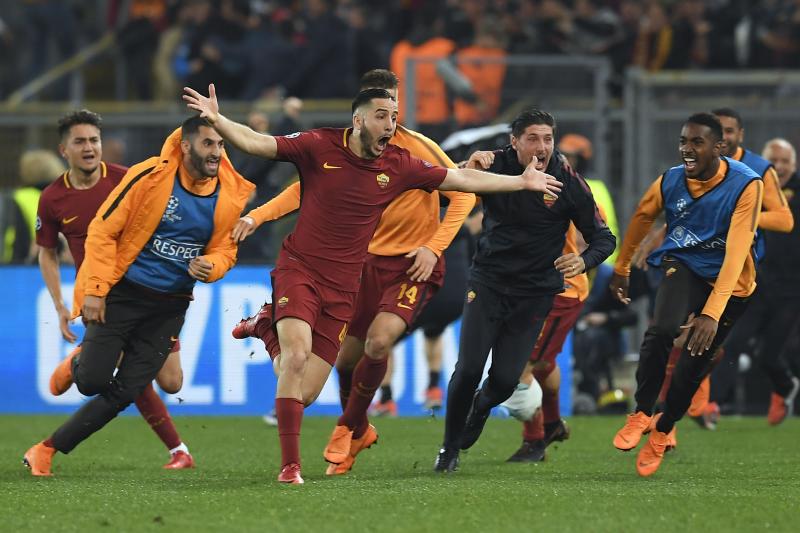
Manolas scores and sparks a frenzy of Roma celebration
For once, Italian football was not a spectator to someone else's resurgence, remontada, or, more fittingly after the last twenty-four hours, someone else's rimonta, the Italian and not the Spanish word for come-back.

Overturning 4-1 deficits, 3-0 deficits, is the preserve of the Spanish and English.  Think Deportivo and Milan. Think Milan and Liverpool in Istanbul.  Think back to just last year when Barcelona did to PSG what Roma did to them last night at the Stadio Olimpico.

Italian clubs are known for negotiating ties more than upturning them.  But after last night, that reputation may start to change.

Roma had to do the unthinkable: score three at home against Barcelona and keep Lionel Messi and Suarez from scoring.  They did both, but it was the latter they did with supreme distinction.  Barcelona were nowhere. Roma had accounted for every blade of grass on the Stadio Olimpico's pitch; everything was in their purview.

3-0 is what they had to achieve, and they did, stubbornly picking away at Barcelona until the Catalan club disintegrated.

When Edin Dzeko scored, you thought, well, it's a matter of time until Barcelona would; when Daniele De Rossi smashed the penalty home, you thought now Barcelona would steal a goal; but when Kostas Manolas headed home for 3-0, the sought-after result, you knew Roma were going to achieve what almost no one thought they could. 

There are times when language betrays you because you have betrayed it in the past; you are out of superlatives, you are out of adjectives because you have squandered them in the service of less deserving occasions. 

At the final whistle yesterday, you thought to yourself, how do you describe something so utterly absurd? That is not to say that the result was a case of anything resembling fluke; no, what makes the 3-0 even more stupefying is that Eusebio Di Francesco legislated for Barcelona in every possible way.

You saw the design.  You saw the organization, but you still asked yourself, how could this happen?

Roma players, hoarse from celebrations, told you how in post-match interviews, almost reprimanding you for not believing.

They believed.  They always had,  they said. Juan Jesus. De Rossi. Radja Nainggolan, all of them had, and all of them had planned for this score.  They had laboured for the miracle: this was no bolt from the blue. 

When Manolas ran to the bench after scoring Roma's 3rd in the 82nd minute, his eyes were open wide, unblinking, the spectacle washing over him, as he tried to take in every blur of flying limbs and screaming fans he could see.  After the final whistle he walked around bare-chested, completely straight, shoulders pegged back. 

His celebration was emblematic of the win: Roma were colossal. 

Now, I hope for a repeat of the 1984 European Cup Final between Roma and Liverpool--and I hope for a different result.

Daje Roma!


Monday, 26 February 2018

Beyond Gattuso's Grinta


In my mind, there is no worse adjective in football than grinta (grit).  I have always read it as a euphemism, or something that only the English national football team used to be proud of having up until the mid-noughties (alongside its almost-as-ugly cousin, determination).  It says without saying explicitly that your grinta is always compensating for your lack of qualita (quality).

Sure, you can have it in addition to some other trait.  As a supplement, it is desirable even.  But bestowed on its own it's practically a pejorative.

Milan coach Gennaro Gattuso may not take it that way because he epitomized it throughout his career.  His nickname is Ringhio, or Snarl, after all.   But it would be reductive to characterize all of the outstanding work he is doing at Milan as an extension of his grit, a simple byproduct of his perpetually elevated voice and heart-rate.

There is method here.  There is geometry.  There is psychology.

Milan didn't sweep aside Roma on Sunday at the Stadio Olimpico for the first time in seven years because of Gattuso's tub-thumping.  They did it after playing a classic Serie A game. They lay in ambush in the first half, absorbing Roma's ultimately meaningless pressure with relative ease.  Then they came out in the second half and moved the ball throughout their team and took two wonderful goals when they needed to.  They used width.  They used the touchline like a tightrope.  I lost count of how many times Franck Kessie picked up the ball right on the line; how many times long balls found their target.

Consider the first goal: it came from Ricardo Rodriguez's long ball to Kessie who headed it down for Patrick Cutrone, who passed it to Suso, who returned the favour with a looping ball that Cutrone touched in.  It was a goal similar to the one against Sampdoria last week in that it started with a precise long ball.  Last week it was Hakan Calhanoglu; this week, Rodriguez.

Then there is the revival of Leonardo Bonucci, who is finally playing with the presence and leadership that Milan fans had wanted.  Alongside Alessio Romagnoli, whose reading of the game is impeccable currently, he forms what could be the best central defensive partnership in Serie A.  Together, they have managed eight clean sheets in about a dozen games.

Cutrone's opening goal was masterfully worked, but Calabria's goal that put Milan up 2-0 was masterfully taken.  The fact it came from a right-back who was confident enough to chip a goalkeeper like Alisson typifies the swagger with which Milan are playing.

The media is gushing over Cutrone, but Calabria, in my mind, is more emblematic of Milan's resurgence.  Cutrone has exploded onto the scene; while Calabria, after a stuttering start, has slowly eased into it, making that right-back spot his own, so much so that it is tempting to forget Andrea Conti.

Calabria is a player who had obvious psychological frailties just like Milan did in the fall, and even now, in this period of upswing, he is prone to errors (his red against Udinese, for example).  Understandable for a 21-year-old; understandable for a Milan side getting used to winning.

But Gattuso handled that red card expertly, saying that it was a result of an ingenuita (naivety) in the youngster.  It is the effort to understand his players in such a short period of time that has propelled Gattuso to where he is now.

Last week he lamented how he hasn't yet managed to get in the head of Andrea Silva. After Milan's embarrassing 2-2 draw to Benevento, he said that it wasn't the time to raise his voice--it was a time for tenderness.

But throughout Milan's success, never once has he taken credit, preferring to play the role that he is typecasted for: the snarler on the sidelines.

Gattuso's greatest strength, then, isn't grit.  It is his self-deprecation, a self-deprecation that downplays his profound understanding of what this team needs.  Gattuso is a paradox: on the one hand he trades in an excess of emotion, and on the other hand he is modest, circumspect, reserved with, and in the face of, praise.

"Maybe I am the worst coach in Serie A," he said in December. "But I want to always win."

He refuses to celebrate now.  He refuses to take the plaudits.  He refuses even to sign a new contract until the end of the season for superstitious reasons.

But if his Milan side continue this extraordinary run, it will be more and more difficult for him to hide.

Friday, 3 November 2017

Calcio Memories: The Lesson of Roma vs Barcelona

Totti fights off Barcelona on February 26, 2002
It could have been 4-0, or even 5-0, but Roma's 3-0 victory against Chelsea this week in the Champions League evokes a precise memory of more than fifteen years ago.

On February 26, 2002, Roma hosted Barcelona in a Champions League group game at the Stadio Olimpico in almost the exact same position as they were at the start of play this past Tuesday--two points behind the leaders, at home, coming off a draw against their opponents in the previous encounter, and not expected to run out emphatic winners.   

Roma coach Fabio Capello started Francesco Totti, Marco Delvecchio, and Gabriel Batistuta on that day, but it was Emerson who opened the scoring.  Well, it's generous to say he did anything intentionally to get the final touch.

Totti received a ball from Emerson in the area, and Barcelona defender Philippe Christenval latched on to him so committedly that his captain's armband came off.  Totti, while dangling the white armband, passed to Vincent Candela whose shot deflected off Emerson into the goal.  Roma went on to score two more goals through Vincenzo Montella and Damiano Tommasi, who replaced Delvecchio and Batistuta respectively.

The Giallorsosi won 3-0 in the end in a game that was memorable not only for the scoreline, but also for the exquisite Roma jerseys on display--two even blocks of maroon and yellow, the Scudetto patch, and the Ina Assitalia insurance company sponsor across the front.

That game was also pivotal in changing the group's complexion at least for that night, but it only proved in the final calculations Roma's glimpse into what could have been.  Their position at the top was short-lived.

Roma drew the next game to Galatasaray 1-1 at the Olimpico,
Stephan El Shaarawy celebrates his goal against Chelsea
meaning they only had to avoid losing by more than one goal away to Liverpool at Anfield.  

They lost 2-0 after goals from Jari Litmanen and Emile Heskey in a game that had a depressing predictability about it before kick-off.  You just knew Roma would collapse.  Gerard Houllier's Liverpool, along with Barcelona, went through to the quarterfinals.

There are similarities this year as well.  Roma lead the group now, needing three points to go through.  They play Atletico Madrid in a testing encounter in Spain before hosting the gritty Qarabag at home.  For Atletico Madrid read Liverpool; for Qarabag read Galatasaray.  

Roma should look to wrap up their progress in Spain, which won't be easy, but given Atletico Madrid's recent struggles, it isn't impossible.  

They brushed aside Chelsea with a comprehensively superior performance on Tuesday, but there is history that suggests Roma should be cautious.  


Saturday, 30 September 2017

On UEFA Coefficients and Serie A's Progress

Papu Gomez celebrates Atalanta's equalizer vs Lyon in the Europa League
In the late summer of 2002, the question of whether Serie A could still be considered the best league in the world seemed more pressing than ever.  No Italian club had reached the quarter-final of the Champions League in the season that had just ended, the national team had disintegrated at the World Cup, and the league's star Ronaldo had left Inter for Real Madrid.

In truth, the question had been asked for years, quietly or stridently, and at the start of the 2002-03 season the answer seemed obvious: no. 

Eight months later, however, Inter, Juventus and Milan were in the semi-finals of the Champions League, and journalists had to revise obituaries.  On May 28, 2003, Old Trafford hosted the first all-Italian Final between Milan and Juventus.  Serie A was vindicated, robed in the glitter of UEFA's premier event, but the game was played in the cagey spirit for which Italian football is stereotyped and maligned, as if the two clubs were determined to torture their detractors, slowly, with flints and chisels.  The Final was rarely carved open.  Milan won on penalties, and Italian football's critics paid them--for being too quick to close the door, to forget the qualities that make Italian football competitive and relevant.

Today, fourteen years later, the question of whether Serie A is the best league in the world has a clear answer yet again: no.  The criteria that many use to arrive at this conclusion varies--entertainment, star power, financial health et al.--but more and more are now using what only a small core of fans did several years ago, the UEFA coefficient system (for a quick explanation of the system check out Bert Kassies's valuable site).

Every Champions League and Europa League matchday, I become a better person and cheer for all Italian clubs.  The reason is sentimental but can also be expressed as a formula.  This season, for every win Italy gets 2 (for a draw 1, for a loss 0) divided by 6 (total number of teams allotted) points, or 0.333 points.  So, this past matchday, Italy managed 5 wins (Milan, Napoli, Juventus, Lazio, and Roma) and 1 draw (Atalanta), totaling 1.833 points.  As a result, Italy climbed up to third spot in the UEFA coefficient rankings, ahead of Germany, and now sits tantalizingly close to England (Spain are far, far ahead).

The meaning of that success has few practical consequences in the immediate term.  Late last year, UEFA announced that the top 4 leagues (Spain, England, Italy, and Germany) would enjoy four representatives in the Champions League from the 2018-19 anyway.  But the coefficient ranking nonetheless quantifies a league's success, setting aside the gnashing of teeth and making numeric the vexed and emotional 'which league is best' debate. 


UEFA Coefficient rankings (image taken from Bert Kassies's site located here)
The UEFA coefficient system does have its flaws.  For example, it weighs victories in the Europa League the same as those in the Champions League, with only bonus points awarded upon progression in the latter to compensate partially for the calculation.  But the system remains the closest thing we have to a deterministic criteria for judging the health and strength of various leagues across Europe.

It also matters for the league's vanity, for its self-esteem.  After every matchday, it is now common for Italian journalists on social media to remind us where Serie A is in the rankings.  And this season, no one expected Serie A to be more than 3.5 points ahead of Germany.  There have been some performances of distinction as well, like Atalanta flattening Everton 3-0 in the Europa League a few weeks ago, and earning a point against Lyon in France just this past week, or like Napoli totally dominating Nice over two legs in the Champions League play-offs. 

This season may be Serie A's best chance to solidify its position in third, and even replace England in second when you consider both the quality of their representation, and that they will have one more representative next season (meaning a higher number to divide the points by, and thus a lower return for a win, for those keeping track).  Milan and Lazio should go deep into the tournament (Milan's ludicrous 3-2 win over Rijeka on Thursday notwithstanding), and Atalanta have started convincingly with four points from their two toughest games.  And then there are Juventus, who have played two losing Champions League Finals in the last two years, but who have nonetheless earned Italy valuable points, and should earn more this year.

Serie A may not be able to repeat what it did in 2002-03 in the Champions League, but the feats of 2014-15 are achievable, and, hopefully, surpassable.  That season, Italy earned 19 points.  Lazio and Napoli played the semi-finals of the Europa League, and Juventus the Final of the Champions League.  The early signs are promising. 


Friday, 6 April 2012

Di Benedetto Delivering for Roma

Sound plans: Thomas Di Benedetto
When Roma's American owners took over in the summer, many were sceptical of their enthusiasm's stamina.  Thomas Di Benedetto, the senescent cherub from the United States who is now the club's president, arrived with plans of making Roma a global brand.  Given the horrific mismanagement of the Sensi family, which had left the club lumbered with debt, Di Benedetto had his work cut out for him.  There was also, of course, the debilitating Italian bureaucracy with which to contend.

Almost a year on, however, Di Benedetto is doing all the right things despite the obstacles.  I have written in the past about Di Benedetto's effort to work with the city council, and recently there has been some progress.

As reported on their official website, Roma recently commissioned the consulting company Cushman & Wakefield to pick a suitable place to build a stadium for the club.  Il Tempo reported that the selected area is Tor Di Valle with 2016 set as the year in which to unveil the new stadium. In the meantime, Corriere Dello Sport reported on Wednesday that Roma have reached an agreement with CONI, which will see them stay at the Stadio Olimpico until 2015, with enhancements to the corporate hospitality areas.

All of these developments come in addition to Roma's recent deal with Disney, which is expected to boost revenues through merchandising.  Roma already saw a 20 million euros boost in revenue last year notwithstanding the fact that they didn't even play in the Champions League.  The future looks promising for the club.

In October, Di Benedetto had said that people "did not understand" where he was taking the club.  Given how things are evolving, one has to praise his ambition.  Despite Legge Crimi being stuck, Di Benedetto has decided to move forward in earnest.


Saturday, 1 October 2011

Serie A Clubs Move Ahead Despite No Legge Crimi

Big plans: Aurelio De Laurentiis
I recently wrote about how the passage of Legge Crimi would dramatically change the modus operandi of Italian clubs when it came to working with a more balanced financial portfolio.  However, as was and is infuriatingly predictable, there seems to be absolutely no movement in passing the law through the branches of the Italian parliament.  Yet, a few clubs have announced their intention to renovate or rebuild a stadium.  It seems in the absence of any forthcoming legal imperative, clubs have shown some welcomed initiative, and the success of their initiative has depended on the extent to which city councils have been willing to negotiate.  For example, in the case of Juventus, the negotiations were swift, and the Turin city council sold the Stadio Delle Alpi to the club.  Of course, given all the well-known problems of the Stadio Delle Alpi--discussed in part here--Juventus elected to level the stadium to build a new home.

While Juventus still lead the way with their privately owned Juventus Arena, replete with commercial and merchandising opportunities, other clubs strive to follow to some degree the Bianconeri's model.  Four clubs are in some stage of improving their habitat.


Napoli: President Aurelio De Laurentiis has exhibited the most bravado.  Before his club's trip to England to take on Manchester City in this season's Champions League, he disparaged his opponents by describing them as unconscientious spendthrifts.  He also called on Michel Platini to be serious in applying the Financial Fair Play Rules.  When he is not antagonizing, De Laurentiis is diligently working to make Napoli a force--on the field and financially.

He has said that he will not bring down the Stadio San Paolo because of its history, but rather improve its existing state, and commercialize the surrounding areas.  He plans on revitalizing the Fuorigrotta area, the site of the San Paolo, during the upcoming summer.  This smaller initiative will contribute to De Laurentiis's broader plan, which includes, as Paolo Bandini tell us, "increasing the training pitches to seven, [and] the construction of living quarter for youngsters, as well as a school building where they can get help with their studies."

Palermo: It is always wise to take what Palermo owner Maurizio Zamparini says with sacks and sacks of salt.  However, even in his capricious universe, he seems serious about creating a brand new stadium for Palermo.  During September of this year, he said that soon Palermo will unveil plans for a new 35,000 seat stadium.  Of course, Zamparini has attempted to build a stadium during his ownership of Venezia as well but was thwarted by the typical bureaucratic problems.  This one will be interesting to follow.

Still trying: Thomas DiBenedetto
Roma: President Thomas DiBenedetto arrived at the club with admirable enthusiasm, announcing that building a new stadium would be the priority.  He had probably not accounted for the intransigence of Rome's city council.  Since those claims, Roma have had to put those aspirations on hold until further notice, and they will have to be content with just trying to improve the matchday experience, which means increased commercial activity around the Stadio Olimpico.  The track between the spectators and the stadium absolutely has to go.

Not the unqualified revolution for which many were hoping, but it remains to be seen whether Roma will get some breathing room in the future to realize DiBenedetto's initial hope of a new stadium.  If the temporary solution turns out to be the one that endures, it will be disappointing.

There were murmurs, however, that Roma could have a new stadium in three or four years.  It all depends on the cooperation of the city council.

Udinese: It is unclear whether president Giampaolo Pozzo has definitive plans to build a new stadium.  Some say that there are improvements planned to the current stadium (with reduced capacity making way for better viewing).  What is ambiguous is whether Udinese plan to own the Friuli (buying it from the city council), or if they plan only to work under the existing ownership.


So the news is mixed.  It appears stubborn city councils are still hindering clubs like Roma, but clubs like Napoli, buoyed also by their exploits in Europe this season, are planning big things.  Meanwhile, Milan vice-president Adriano Gallian refuses to cheer up.  He maintains that the feat Juventus have managed in building a new stadium cannot be achieved in Milan.  "The most we can do," he maintains, "is improve the San Siro and make it suitable to host the Champions League Final."  Not the ideal news for Milan fans who were hoping to rival Juventus with their own home.

Nevertheless, as clubs wait for Legge Crimi, which may be far off in the future, a lot of work remains to be done, but clubs are taking some steps forward.

Thursday, 5 May 2011

Memory: Andriy Shevchenko Strikes for Scudetto

Almost exactly seven years ago, on May 2, 2004, Milan's Andriy Shevchenko scored what proved to be the game and Scudetto winner in the second minute against Roma at the San Siro. Cafu collected the ball in midfield, and passed it to Kaká, who resisted one challenge before crossing the ball for Shevchenko to head home.

On Saturday, there will be no Cafu, Kaká, or Shevchenko, but there will be Ignazio Abate, Kevin-Prince Boateng, and Zlatan Ibrahimovic, and Milan can claim their eighteenth Scudetto against Roma at the Olimpico with just a draw.

Forza Milan!