Saturday, 23 June 2018

Dino, The Other Baggio

My early memories of Gli Azzurri coalesce around Roberto Baggio.  How could they not? During the 1990 World Cup he was 23 and jostling for preeminence; four years later, it seemed that he was doing the same. Absurdly. Criminally.

It was June 23, 1994.  Ireland's Ray Houghton had condemned Italy to defeat in the first group game, so they were playing Norway in a must-win encounter.

The early signs were promising.  Coach Arrigo Sacchi fiddled with his methods, switching from two forwards that he had used against the Irish to three against Norway: Baggio, Pierluigi Casiraghi, and Giuseppe Signori.  He also brought on Inter's Nicola Berti in place of Sampdoria's Alberigo Evani in midfield. 

Italy seemed on the verge of a goal until the 21st minute when goalkeeper Gianluca Pagliuca rushed off his line and fouled a Norwegian player.  He was shown a red (later he joked that "at least I entered history"). 

Lazio's Luca Marchegiani stood up to replace Pagliuca.  The question was which outfield player would come off.  Sacchi opted for Roberto Baggio, the coach slipping seamlessly and callously into the role of anti-hero.

I was livid.

Baggio looked around, scanning his teammates for an answer.  "Who me?" he asked them, totally bewildered.

It was to be him.  Baggio came off.  Sacchi would stand with the weight of his decision on the sidelines for the rest of the game.

It would get even worse.  Captain Franco Baresi came off in the 49th minute with a knee problem, the less illustrious Luigi Appolini taking his place in defence.  Whatever could go wrong for Italy had.  Sacchi had removed the man the press and the fans adored; a suspect knee had removed the defensive stalwart.

Italy toiled for a goal in the Giants Stadium of East Rutherford, New Jersey.  It came from Baggio, finally.  No, not the one watching from the sidelines, but from one who wasn't even related to him.

It was Dino Baggio, the lanky Juventus midfielder.  He rose to meet a Signori free-kick, delivered with sumptuous precision, to smash a header past the Norwegian goalkeeper.  There were still more than twenty minutes left to play, but you had the feeling that Italy had done what they needed to. 

And so it proved.  Baggio, Dino, not Roberto, ensured the victory.  Sacchi's decision to take off Baggio, Roberto, not Dino, didn't prove as costly as feared.

At the time, I was fifteen.  I just remember my joy at Dino scoring, and I remember my anger at Roberto trudging off.  I wasn't aware then of the broader debate.  English language broadsheets stripped the national significance of the Baggio substitution; they could never capture the recrimination in Italy.

It is only with the benefit (or drawback) of hindsight that I can now put into context all that was going on.  Articles.  Books. Videos.  My ability to speak Italian.  All these things at once enrich and dilute my memory of that day.

Even the audio in my head has been replaced by commentator Bruno Pizzul's voice faltering at the substitution, before rising again at the goal. 

The Sacchi-Baggio subplot now colours almost everything.

But the victory remains unadulterated.  The essential Italian victory, on this day, twenty-four years ago.


Tuesday, 19 June 2018

Baggio, The Man With "Educated Feet"

Italy is not in this World Cup, but my memory can rival its HD.  In it, Roberto Baggio is not frayed at the edges.  His memory doesn't yellow or smear.  No, in it, Baggio emerges from the grainy fog of a 1990 broadcast a speckless blue, his perm bobbing, his i piedi educati, or educated feet, talking, teaching.

They dialogue with Giuseppe Giannini in a 1-2.  They are at times diplomatic.

He skips, floats past the Czechoslovakian players.  They are at times duplicitous.

One Czechoslovakian, two, (maybe three)? It's irrelevant.

What matters is that Baggio spies space.  Openings. Percentages.

He scores.

And then he collapses, lapping up the adulation.

On this day, 28 years ago.


Tuesday, 17 April 2018

Udinese's and Italy's Stefano Fiore

Inzaghi and Fiore (right) celebrate the goal against Belgium
Stefano Fiore celebrates his 43rd birthday today. Here is a look back at his career.

At Euro2000, the usual debate of 'which superstar should play' had followed the Italian national team into the tournament. Was it to be Francesco Totti or Alessandro Del Piero?  After the group stage, it seemed coach Dino Zoff preferred a twenty-three-year-old Totti to Del Piero.  The Roma man started the first two victorious games for Italy against Turkey and Belgium, scoring in the latter; Juventus's Del Piero started the last meaningless one against Sweden, in which he nonetheless scored a blistering winner in the 88th minute.

The debate staged the usual regional anxieties and allegiances that the blue of the Azzurri never seems to soothe completely.  But while the media quibbled over their preferences, a Cosenza native by the name of Stefano Fiore had announced his arrival on the international stage with a breathtaking goal of his own against Belgium.  

Fiore didn't represent any of le sette sorelle (the Seven Sisters)--a now disfigured sisterhood, but once comprised of the ultra-competitive clubs of Parma, Roma, Lazio, Milan, Inter, Fiorentina, and Juventus.  He had just finished an outstanding season at unfancied, sensible Udinese in which he scored nine goals playing more of an attacking role in Luigi De Canio's midfield.  Zoff deployed him closer to the strikers, but he considered him equally adept at playing a more conventional position in central midfield.  Fiore was even deployed on the left flank during his career as well.

It was a bittersweet versatility.  

"My preferred position has always been to play inside of a 3 or 5 man midfield, but it was where I played less in my career," he recently said in an interview to fantagazzetta. "I have played as a regista and often as a trequartista, and even on the flank."

His goal against Belgium at the Baudouin Stadium that summer night illustrated precisely what Fiore was capable of when played closer to the front, as he exchanged a quick pass with Filippo Inzaghi before releasing an unstoppable shot from near the edge of the area.  But it was his celebration that was emblematic of his career: pointing to his name on the back of his jersey as he wheeled away, Fiore was reminding everyone that he still existed, that he still mattered.  

That night he earned his sixth cap for Italy at the age of twenty-five, but only keen followers of Italian football knew who Fiore was.  His career wasn't particularly decorated, even if at Parma he had won a UEFA Cup serendipitously at only the age of twenty.

"I was co-owned by Cosenza and Parma, but I ended up at Parma after they won a bid," he recalls.  "I was playing for the youth team, but then found a place in the senior side, and won the UEFA Cup."

In 1999, he would win the UEFA Cup again with Parma after
Fiore in action for Udinese
playing a much more crucial role in that season, but he only came on as a substitute for Juan Sebastian Veron in the 77th minute of the Final against Marseille.  Marginalized, Fiore went to Udinese where he finally earned the recognition that he had sought.  

But his success was transient.  After Udinese, came Lazio, Valencia, Fiorentina, and Livorno but Fiore was never able to replicate the success of the years between 1999 and 2001 (it should be noted that he had his moments while playing for Lazio and Fiorentina).  That period was his apotheosis as a footballer, and near the end of his career Fiore slowly faded into relative obscurity.

For Italy, after that game against Belgium, Fiore continued to have a remarkable tournament.  He provided an assist for Totti's goal against Romania in the quarter-final, and started the Final against France, which Italy lost to a golden goal.  When I watch replays of that Final even now after seventeen years (I make sure to end my viewing right before Wiltord's equalizer, of course), I still allow myself a smile when the panning camera lingers for a second or two on Fiore during the Italian national anthem.

I read about him in April of 2017 after he was involved in an accident in Rome that killed a 22-year-old man.  Fiore was cleared of any culpability in the death.  Fittingly, he now works for the youth sector of the club that propelled him into recognition--Udinese.  


Wednesday, 11 April 2018

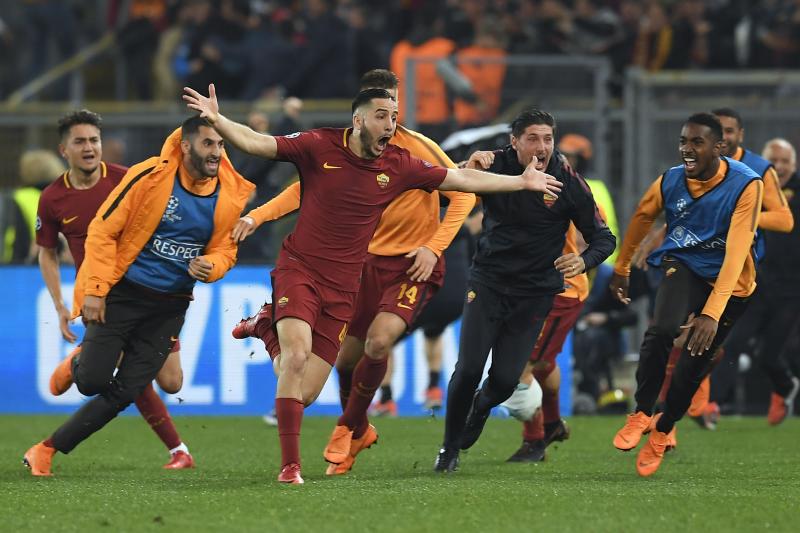
Daje Roma!

Manolas scores and sparks a frenzy of Roma celebration
For once, Italian football was not a spectator to someone else's resurgence, remontada, or, more fittingly after the last twenty-four hours, someone else's rimonta, the Italian and not the Spanish word for come-back.

Overturning 4-1 deficits, 3-0 deficits, is the preserve of the Spanish and English.  Think Deportivo and Milan. Think Milan and Liverpool in Istanbul.  Think back to just last year when Barcelona did to PSG what Roma did to them last night at the Stadio Olimpico.

Italian clubs are known for negotiating ties more than upturning them.  But after last night, that reputation may start to change.

Roma had to do the unthinkable: score three at home against Barcelona and keep Lionel Messi and Suarez from scoring.  They did both, but it was the latter they did with supreme distinction.  Barcelona were nowhere. Roma had accounted for every blade of grass on the Stadio Olimpico's pitch; everything was in their purview.

3-0 is what they had to achieve, and they did, stubbornly picking away at Barcelona until the Catalan club disintegrated.

When Edin Dzeko scored, you thought, well, it's a matter of time until Barcelona would; when Daniele De Rossi smashed the penalty home, you thought now Barcelona would steal a goal; but when Kostas Manolas headed home for 3-0, the sought-after result, you knew Roma were going to achieve what almost no one thought they could. 

There are times when language betrays you because you have betrayed it in the past; you are out of superlatives, you are out of adjectives because you have squandered them in the service of less deserving occasions. 

At the final whistle yesterday, you thought to yourself, how do you describe something so utterly absurd? That is not to say that the result was a case of anything resembling fluke; no, what makes the 3-0 even more stupefying is that Eusebio Di Francesco legislated for Barcelona in every possible way.

You saw the design.  You saw the organization, but you still asked yourself, how could this happen?

Roma players, hoarse from celebrations, told you how in post-match interviews, almost reprimanding you for not believing.

They believed.  They always had,  they said. Juan Jesus. De Rossi. Radja Nainggolan, all of them had, and all of them had planned for this score.  They had laboured for the miracle: this was no bolt from the blue. 

When Manolas ran to the bench after scoring Roma's 3rd in the 82nd minute, his eyes were open wide, unblinking, the spectacle washing over him, as he tried to take in every blur of flying limbs and screaming fans he could see.  After the final whistle he walked around bare-chested, completely straight, shoulders pegged back. 

His celebration was emblematic of the win: Roma were colossal. 

Now, I hope for a repeat of the 1984 European Cup Final between Roma and Liverpool--and I hope for a different result.

Daje Roma!


Tuesday, 27 March 2018

Italy's Familiar Unfamiliarity With England

Daniele De Rossi takes the questions before Italy vs England
Ahead of the friendly between Italy and England tonight at Wembley, looking back at the build-up to the Euro 2012 quarter-final reminds us of the complicated footballing history between the two nations.   

Italy's Daniele De Rossi, amid the battery of Mario Balotelli questions, gave perhaps the most telling response to how Italy felt going into their quarter-final match against England in Kiev on Sunday: "It would have been better to have played Ukraine, but it's okay like this as well."

That Italy would have preferred, with all due respect, Ukraine to have gotten through is obvious, but I think they would have preferred playing France to England as well, and this despite
Les Bleus having brought so much pain to Italy in World Cup 1998 and acutely in Euro2000. Even if De Rossi had been all bravado in front of the media, it would have been a hollow performance, beyond the tiring platitude of press conference in football.  Unmistakably, Italy are distinctly uneasy about playing England. 


While English opinion has, for not an insignificant part, been impervious to Italy's successes, operating in an obsolete currency that still circulates notions like Italy play defensive and cynical football, Italian opinion of English football can be frayed at times by the pressure of the occasion, but at the core is built on an almost fearful respect.


Sure, Paolo Di Canio may have said that Roy Hodgson's men remind him of an "Italian team of the 80s," but he was not suggesting that England have regressed.  If anything, Italy know that this England team has teeth: Hodgson has predicated a revival of spirit and self-belief on Fabio Capello's organization.  At times this organizational form has threatened to disintegrate in this tournament, most notably against Sweden, but it remains intact.

But quite apart from how England "set out" in a game, there exists in traces a cultural deference in Italy for English football and its players. "[Steven] Gerrard remains my idol," said De Rossi.  Considering De Rossi is only three years Gerrard's junior and a World Cup winner, I found the praise a bit exaggerated.

There is a historical precedent for this kind of flattery, a precedent that was rooted in a clear dislike for the English as well.  In the 1930s, Italy were crowned World Champions twice under the aptly named Vittorio Pozzo.  However, there remained a need to vanquish the creators of the sport, the team who were considered superior despite having not entered any of the World Cups during the 1930s.  England were still seen by the English themselves, and to be fair, by many others, as the best team in the world.  And of course, politically this need to vanquish the English was also rooted in Fascist ideology that depicted them as "imperialists and gluttons" (Foot, Calcio, 479).

Vittorio Pozzo 
One of the most high-profile matches between Italy and England during this time took place on November 14, 1934. Italy were the reigning World Champions but the game was seen, in the words of John Foot, as being the proper "deciding play-off": "The winner of the game would be declared--unofficially--as the best team on the planet" (Foot, Calcio, 479).

Italy lost the game 3-2, but it hardly matters now in the broader calculus of superiority, in which there is absolutely no contest: Italy have won four World Cups to England's one, and one European Championship to England's zero.  At club level too, despite the bellowing of Liverpool and Manchester United fans, not one English club has seized Europe the way Il Grande Milan did in the late 80s and early 90s.

Yet, currently, the Premier League remains the pinnacle of modernity, with only the German Bundesliga rivalling it for commercial power.  Serie A, on the other hand, has been plagued by scandal, financial mismanagement, dilapidated stadia, and racism.  On the field, however, notwithstanding the fragmentation around it, Italian football remains singularly clear on the importance of success.  English clubs, though, have always presented huge troubles for Italy in Europe--not just on the field either.

The Heysel Tragedy of 1985 remains a plaintive and infuriating chapter for Italian football fans, specifically those of Juventus.  The thirty-three Juventus and six Liverpool fans who were smothered to their death as a result of English hooligans inundating a section containing Juve fans always tartly contributes to the narrative of Italy and England.

On the field, there is of course the heartbreak of Roma and Milan losing to Liverpool in the European Cup finals of 1984 and 2005, and, most recently, Milan having trouble with English opposition between 2008 and 2011, during which time they were eliminated from the Champions League by Manchester United, Arsenal, and Tottenham.

While Italian clubs have indeed recorded memorable victories over English ones in Europe (Milan defeating Manchester United and Liverpool to 2007 glory, and Napoli, most recently, gliding past Manchester City), there is a tendency to believe that English football has the requisite antidote to the Italian game: an athleticism, a sense of width that troubles Italian teams.

Tardelli gives Italy victory over England
But international football is not the cumulative expression of club football.  Success in it depends on psychology and many tactical choices based on pressures of time, and both Italy and England have had a frenzied build-up to the tournament.  England had a managerial reshuffle with Capello making room for Hodgson, while Italy had to deal with the scandal that saw their valued left-back Domenico Criscito sent home.

The Azzurri may have some apprehension going into the game tomorrow, but they know they have what it takes, in theory, to beat England in a proper tournament.  The third-placed play-off in World Cup 1990, while memorable, was an afterthought, and Italy's last victory over England in a tournament before that came thirty-two years ago in the 1980 European Championships when Marco Tardelli gave them a 1-0 victory.  Italy and England have only played twice in major tournaments, which lends a mystique to the quarter-final on Sunday.

Given the success Italy have had over England internationally, their apprehension may seem misplaced.  Sunday will be a psychological tussle between two teams who have a lot of history around them, but only a bit of competitive history between them, directly on the field.  It is this familiar unfamiliarity that colours this contest unpredictably.  Ludicrously, despite their high-profile, England remain a bit of an unknown quantity for Italy, and vice-versa, but I get the feeling, based not on empirical reality but my own unscientific hunch, that England can accommodate that unfamiliarity by the strength of their own conviction (I still don't believe that this accommodation will lead to an English victory by any means).

I have read, on more than one occasion, that Italy are not a real threat to this English team, and the fact that Spain were avoided is a cause for understated celebration.  Certainly, on paper, Italy appear to be a more manageable opponent than the reigning World and European Champions, but it is precisely paper that cannot contain or define this game.  To me, Italy and England on Sunday is still an unknown, which makes it intriguing, but also frightening.

Forza Azzurri!

Tuesday, 6 March 2018

The Latest Iteration of Napoli's Failure

A familiar dejection: Napoli
After Roma squashed Napoli 4-2 over the weekend, I couldn't help but think we've been here before.  The contours of Napoli's capitulation were familiar.

Napoli's defeat, coupled with Juventus's last-gasp win over Lazio, felt pivotal, even decisive in the title race. 

And, I can sort of predict the aftermath as well.

I expect that soon Napoli president Aurelio di Laurentiis will remind everyone of the club's extraordinary achievement despite not being as rich as Juventus. Then he will call the Stadio San Paolo a toilet, and reiterate that the Napoli mayor, Luigi de Magistris, has stymied his efforts for a new stadium. 

(Perhaps he will spare us musings on more outlandish topics like the hygiene standards of English women).

Add a bit of bluster and shots at the power brokers in northern Italy, and a reminder that the Champions League is the only tournament Napoli should be playing in.

Then, next year Napoli will exit the Champions League group stage. Everyone will laud them for failing so so gallantly.  Coach Maurizio Sarri (assuming he's still there) will moan about how ludicrous the Europa league is. At some point, they will rush back at least three key players from hideous injuries (like they did with Faouzi Ghoulam and Arkadiusz Milik) and two of them will snap some more ligaments.

It seems to me that this club hasn't understood that winning engenders winning.  They scorned the Europa League--openly, brazenly--only to lose (in all probability) the Scudetto two weeks later.

Admittedly, Sarri is a fine coach, whose Napoli team is easy on the eye. 

My gripe is more that whenever they have had to play a key game in recent memory, Napoli have fluffed their lines (Athletic Bilbao, Juventus, Dnipro, Roma etc.). 

And that is not only Sarri's failing (Benitez was in charge against Bilbao in the 2014 CL qualifier, for example) but also the club's. Di Laurentiis sets the tone when he privileges one tournament over the other, which I think has harmed Napoli more that it has helped them.

But I do have reservations about Sarri the psychologist, motivator, or trascinatore. I am not suggesting that a tub-thumper is what is necessarily required, but Napoli look really unprepared sometimes. The Europa League defeat to Leipzig at the San Paolo was particularly disappointing, albeit predictable.

There was no excuse for Napoli to fold like they did against Roma either, especially when you consider there had been no European exertion a few days earlier. Had they won, they would have gone 7 points ahead of Juve, and the Bianconeri would have had to play their game in hand against Atalanta with a lot more pressure. 

Roma's Scudetto in 2001


Batistuta and Montella celebrate Roma's equalizer
There are some comparisons to be made with the club that brushed aside Napoli at the San Paolo on Saturday.  When Roma won the Scudetto last in 2001, Fabio Capello managed all aspects of the team convincingly. You need that type of coach sometimes to break the mould at a club, especially at a club like Napoli or Roma, where the organizational structure and the financial strength have been comparatively inferior to that of Milan and Juventus.

During the game Saturday, I thought back to Roma's 2-2 draw against Juventus in the 2000/01 season, when Hidetoshi Nakata scored a bullet from long-range and Vincenzo Montella equalized in the 90th minute. Roma were down 2-0 after just six minutes, but they managed to claw their way back at the Stadio Delle Alpi.  That victory kept them five points ahead of second-placed Lazio at the time, but, more critically, claiming a draw in Turin preserved their psychological edge in the title race.

There have been no similar moments for Napoli in recent years.  Napoli did demolish Lazio 4-1 in February after going a goal down early, but they couldn't overturn Roma.

Sure, it helps when you have players like Gabriel Batistuta, Francesco Totti, Montella etc. like Roma did, but Napoli also have a lot of quality, and some players are playing beyond themselves--I'd be curious to see how Ghoulam and Jose Callejon fare outside of this Napoli, for example.

I am not suggesting Capello is a phenomenal coach, or that Sarri isn't; more, I have doubts about whether Sarri can finish the job.

There are still more than ten games left in the season, but it seems inevitable that Juventus will now win an unprecedented seventh Scudetto in a row.