Thursday, 11 July 2013

Milan and Inter Could Develop the Area Surrounding The San Siro

La Gazzetta dello Sport published an article recently reporting that the City of Milan is open to
Pact: Milan CEO Galliani (left) and Inter owner Moratti
Milan's and Inter's plan to buy the area surrounding the San Siro Stadium, the Trot area.  It is reported that Milan and Inter are going to enter a "pact" to capitalize on potential commercial opportunties in the area, a sort of sports village boasting restaurants and offical stores.

On June 24, Milan CEO Adriano Galliani had communicated that both clubs were trying to purchase the Trot area surrounding the stadium to prepare it for the Champions League Final of 2016, which the San Siro may very well host.

According to the Gazzetta article, both clubs are set to negotiate with SNAI, the company who owns the area.  The clubs' initial offer is between 40 and 50 million euros.

Interestingly, Milan have also promised to repay whatever investment Inter make if Massimo Moratti's club decide to build their own stadium in the near future--a possibility given that Indonesian businessman Erick Thohir, who is interested in buying the club's shares, has communicated his willingness to help build one. 

It is reported that the days between July 15 and 20 could be "decisive" for the negotiations.  Galliani recently said that Milan would stay at the San Siro until at least 2016.  He said a new stadium project would take time, and also expressed how Milan have unsuccessfully tried to purchase the San Siro in the past.

Monday, 17 June 2013

Mangia's Moment With The Azzurrini

Italy U-21 coach Devis Mangia is a casualty of Palermo owner Maurizio Zamparini, which means, as
Coach Devis Mangia of Italy
it does with many other victims of the peevish, eccentric man, he is eminently competent and ambitious. The young Mangia lasted three months in charge of Palermo's senior team in 2011 (he had coached the U-19 club team before that), taking over from the departing Silvio Piola.

"I hope Palermo becomes the Arsenal of Italian football, and Mangia our Wenger," gushed Zamparini on September 12th, 2011, a day after Mangia had led Palermo to a memorable 4-3 win over Inter. There were a few things to note following that victory: the serial-sacker Zamparini imagined the concept of patience for a short moment, Mangia defeated Inter on his first day in charge of Palermo's senior team , and he did it using a relatively simple 4-4-2 system.

At 37, Mangia had finally arrived emphatically, gleefully hopping over the final threshold into the glare after an arduous coaching journey. The dust and heat of Italian football's sideshows--clubs like Varese and Valenzana was where Mangia had matured as a coach--had configured him for the big-show. He lasted only for two more months after that September when a loss to Catania prompted Zamparini to do what he does best: sublime destruction.

Mangia got as close to Wenger's longevity as the Frenchman has to a trophy since 2005, but that was only a marginal detail. It was bound to happen in Zamparini's airless world. More importantly, Mangia saw his football ideas take discernible shape, and he grew in confidence.

It is that confidence, and that 4-4-2 formation, that he has used so adeptly at the European Championships this summer. His Azzurrini play Spain tomorrow in the Final of the tournament, and up until now they have displayed a brand of football that is direct and decisive, premised on a passing game free of fear.

They have defeated England with a wickedly misleading 1-0 scoreline (Italy's superiority deserved much, much more), swept aside Israel 4-0, outplayed Norway in a 1-1 draw, and edged Holland 1-0 in the semi-final after a visceral performance, one that was a case study of the brute force method: tolerate pressure, foul, stifle, and then assert yourself ruthlessly when you get the space.

"This Italy has great quality," Mangia said after the semi-final. "We were better organized on the field, and we were balanced."

While the semifinal didn't epitomize Italy's redoubtable qualities, their tournament as a whole has been scintillating. Napoli's Lorenzo Insigne has scythed grass and air with his incisive forays in midfield and the final third, Marco Verratti has been threateningly undisciplined sometimes, but an expert orchestrator most times, unlocking play from various positions in the field.

Leading from the front have been Ciro Immobile and Fabio Borini, both able to read each other and the unit
Lorenzo Insigne surrounded by teammates
behind them deftly. Borini did disappoint in the early stages of the tournament, but he scored the winner against Holland with a brilliant moment of improvisation.

The backline has held together too, conceding only one goal, and that from a penalty in the 1-1 draw against Norway. Interestingly, Inter have contributed a good portion of the defence in goalkeeper Francesco Bardi, and defenders Luca Caldirola and Giulio Donati.

But despite such raw material it is Mangia who has conferred upon the group a sense of organization and adventure, which can see Italy flourish their tournament with a victory over Spain.

As coach of a country that has won this tournament a record five times, Mangia resorted to the prosaic in a moment when all were reaching for the poetic to describe Spain.

"I don't mind if they [Spain] are the favourites because I know on June 18 there will be a green pitch, 11 players, a ball in the centre circle and we will start at 0-0," said Mangia, emphasizing the mundane details to calibrate his young team's nerves no doubt.

"When we started the tournament I said to the players to take it step by step. Now we only need to take one last step."

And rest assured Mangia will be aching to take another huge step after the one he took at Palermo. For a man who describes former Milan and Italy coach Arrigo Sacchi as his greatest influence, Mangia knows that it takes a pivotal moment, a pivotal few games, to be thrust into the elite. After all, it was Milan's Coppa Italia defeat to Sacchi's Parma in 1987 that led Milan owner Silvio Berlusconi to pick him as his coach.

Mangia has achieved amply already, but a win will be consistent with his style. Ever since he took over this U-21 team from Ciro Ferrara last summer, he has blazoned it with daring. This Italy believes, and so does Mangia.

And we should, too.

Forza Azzurrini!


Saturday, 8 June 2013

El Shaarawy's Significance--A Fan's Perspective

Must stay: Stephan El Shaarawy
If for nothing else, then for interest of self-preservation, I have to take the recent rumour that Manchester
City have bid 40 million euros for Milan's Stephan El Shaarawy positively.  Not for any pecuniary reasons, of course.  I  don't hold out hope that if Milan were to accept the bid they would invest it in the market, and I certainly do not obsess over balanced books.

Rather, it will give Milan fans an opportunity to see how genuine our management's talk of a youth revolution is.  At 20, El Shaarawy is emblematic of Milan's youth policy, representing not only a critical part of the team, but also the Milan image that Silvio Berlusconi values so much: disciplined, good-looking, and in love with Milan.  Kaka had it before he faded into Madridian obscurity.  El Shaarawy has it now.

Before Mario Balotelli's arrival in January, El Shaarawy was prodigious.  Yes, he has been diffident since, but Milan are precisely in the business of nurturing players now--or so they say.

If Milan sell El Shaarawy, then, not for the first time, the management publicized lies, telling us that Milan was now done selling big players for money.  The books, as Milan CEO Adriano Galliani is so fond of telling us, are balanced.  The team needs some key reinforcements to be formidable.   El Shaarawy's sale would represent a total capitulation, not only to the rich of the football world, but to the club itself and what it purports to stand for.  And if Milan don't invest the money significantly, then we have to question how much of ourselves we should invest in this club.

If Milan are grooming players to sell them for high profits, then we are no different than Ajax, Porto, and Udinese.  Ever since the summer of 2006, in the wake of calciopoli, clubs have sensed that with the right price they can buy Milan's best players.  It seems the Milan management is  faced with torrid tentazione (temptation) in the summers, and Milan fans have to suffer the speculation and hang on every word Galliani says.   Andriy Shevchenko was sold because he wanted to leave--fair enough.  Kaka, Thiago Silva and Zlatan Ibrahimovic were sold to settle debts--also fair enough (just about).

Now, Milan have no debt--except to us as fans, who have had to endure a massive upheaval at the club to finally see a coherent team rise to the top, one built on fiscal sanity.  There would simply be no excuse to sell El Shaarawy.

The good thing is the test for our management has come early.  We will not have to wait long to see if they mean what they say.


Monday, 20 May 2013

Despite Huge Relief, Questions Persist for Milan and Allegri

Win...Montolivo embraces Mexes as Zapata looks on exultingly
Controversy, recriminations, and managerial departures--the Serie A season ended in typical fashion in Italy.

Except, maybe, for Milan, who found themselves in an unusual place of having to fight for a Champions League spot.

As the minutes wound down in the Stadio Franchi carapace--more hollow than usual because of the almost completely empty seats--Milan looked set for a dispiriting defeat to a Siena team that was already relegated.  The last Champions Leage spot was increasingly looking purple, as Fiorentina were busy carving up  Pescara.  They were cruising at 5-1; Milan sinking under the weight of one solitary strike delivered by Claudio Terzi in the first half, when the Milan defence froze to allow him to glide in and score a simple header.

Eighty-four minutes had gone, and Adriano Galliani's jowls hadn't even twitched once in the stands.  He sat there more lugubrious than Vicente Del Bosque, flanked by the ubiquitous pair of Ariedo Braida and his son.

To put it mildly, it didn't look good. CaptainMassimo Ambrosini had been sent off, Milan had come close thrice--once with Mario Balotelli crashing a header off the crossbar--but hadn't scored, and the midfield looked like they were allergic to passing.

Then, the intervention in the 83rd minute. For the rest of the Serie A, especially Fiorentina, there was nothing divine about it--it was a secular intervention of wickedness.  Referee Mauro Bergonzi saw a forceful enough tug on Balotelli and awarded a penalty. With Balotelli, penalties are a foregone conclusion (he hasn't missed one for Milan or in his career), and it was 1-1 with about ten minutes left (with injury time).  Three minutes later, Milan floated in a free-kick, and Philippe Mexes prodded it against the goalkeeper, and prodded again past him.  It was 2-1.  There was delirium in the Milan camp, as Galliani finally celebrated with the usual abandon.

The penalty, of course, was velvet-soft.  As the thin crowd chanted "ladri, ladri" ("thieves, thieves") in the stadium, you could sense what was to come.  Fiorentina defender Manuel Pasqual frankly said that Milan were "gifted" the penalty, while Gonzalo Rodriguez affirmed his simmering outrage by not affirming it: "if I say what I am thinking, I will not play in Italy again."

Milan were more than fortunate to scrape through, and Fiorentina have every right to feel aggrieved about yesterday.  But taken in the context of the season, Milan just did about enough to qualify for the Champions League, even if they made it as nerve-shredding as possible.

The credit and some of the discredit for that goes to coach Massimiliano Allegri.  Those who clamour for his dismissal--including the less-than-cerebral owner Silvio Berlusconi--would be advised to think how far he has brought a team that saw the departure of Zlatan Ibrahimovic and Thiago Silva amongst a host of other players who either retired or left Milan after several years.

I think Allegri should stay, but he has to improve the team in one chief area: how they approach crunch games.

Even in Allegri's championship-winning season of 2010-11, Milan pandered to the neutral's taste for drama far more than they needed to.  They let Inter get perilously close to them, before winning in a direct encounter, a game that saw them surge four points ahead at a decisive stage of the season.

Last season, Milan let Juventus surpass them right near the end, capitulating to a 1-1 draw to Fiorentina when a win was their only option.  And, of course, this season, let's not forget Milan redeemed themselves after an understandably tumultuous start, and they were, at one point, a mere point away from Napoli in second, and quite comfortable in front of Fiorentina.  That they needed a dubious penalty, and Mexes's toe-poke to get to the preliminaries of the Champions League hints at a lack of mettle when it was required most.

Notwithstanding all of that, Allegri still remains the right man for the job, even if he needs to fine-tune his approach.  The fans and players are all behind him, as was in ample evidence in their public show of support in recent weeks.  Berlusconi is capricious and self-obsessed, but even he should be dissuaded from the madness of appointing someone like Clarence Seedorf (as is being reported), who has no coaching experience and who spent not an insignificant amount of his latter matches at Milan peevishly sleep-walking in midfield, as coach!

But at the time of writing, it is still not clear where Allegri will be next season, with a meeting on Wednesday to decide his fate.  As I have said, I want him to, and I believe he will, stay, but he will also want some guarantees in terms of the transfer market.

Milan desperately need one who is able to deputize for, or even play with, Riccardo Montolivo, one current Rossonero who can actually distribute in midfield.  And in defence, though Ignazio Abate has been enterprising as ever on the right flank, Milan need someone who can actually cross.  Further, as Galliani has indicated, Milan's need for a central defender is also urgent, someone who can add to the fairly impregnable duo of Mexes and Cristian Zapata.

Lots of questions ahead during the summer, and it will be intriguing to see how, or if, Milan honour their commitment to bring in youth and important players for Milan.  There has been lots of talk of a fiscal revolution that allows for purchases, and no more painful sacrifices of players being sold--let's see how genuine it is.


Sunday, 31 March 2013

Udinese, Yet Again The Example

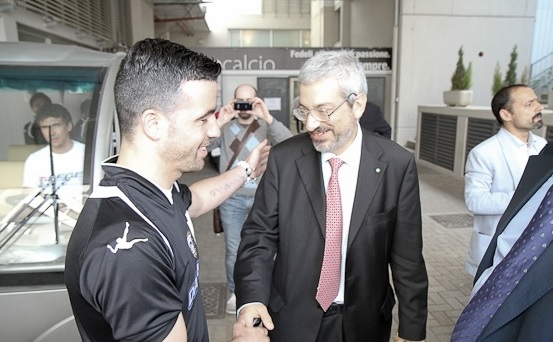
Udinese captain Antonio Di Natale (left) greets Mayor Furio Honsell 
The mayor of Udine, Furio Honsell, is probably used to tortuous complexities given that he was a Professor of mathematics at the Università di Udine until he decided to enter municipal politics in 2008.  He ran successfully as a center-left candidate in the mayoral elections in April of that same year, succeeding the conservative Sergio Cecotti, and has since been the incumbent.

Italian football fans who don't have a keen interest in Italian polity had probably never heard of him until Friday, when Udinese owner Giampaolo Pozzo emphasized Honsell's "bureaucratic miracle" in helping complete the deal that will finally allow, after a ten-year quest, Udinese to begin construction and maintenance work on the Stadio Friuli, which they will now own.

And it was probably not hyperbole on Pozzo's part.  In the absence of any binding legislation, it is a colossally complicated task to ratify construction or the rehabilitation of stadia across Italy.  To Honsell, the challenge of the Italian bureaucracy must have surpassed the one of Lambda Calculus.  Mediating between the city council, eager to exact rent for the stadium, and the club, longing for private ownership of the stadium to boost revenue, must have been an arduous negotiation.

In the late fall of 2011, Honsell communicated how difficult things were, announcing that he was trying to find a solution for Stadio Friuli's refurbishment, and the logistical requirements of concerts in the stadium.  It is precisely these pressures that make club ownership of stadia so difficult in Italy.  City councils want to ensure their own large stake in lucrative activities that go on in the stadium, and by keeping a firm grip on ownership they can do precisely that.  

It is to the mayor's credit that he ensured Udinese become the third club--after Reggiana (not to be confused with Reggina) and Juventus--to own their stadium, granting a huge boost to a club that has been conscientiously profitable on a modest budget for years.

Similar to Juventus's deal with the Turin coucil, Udinese have obtained a land-lease of 99 years.  They will begin working on the stadium after the end of the current season, reducing its capacity by about 16,000 to 25,000 seats.  Crucially, however, they will now be the exclusive, private owners of the stadium, which allows them to capitalize on matchday revenue without having to pay onerous rent to the city council.

The latest "lease" from the city in this case is nominal and symbolic:  a small sum paid at up front, similar to the single euro that Juventus paid the Turin council before they demolished the Stadio Delle Alpi and built their glowing Juventus Stadium in its place.

Udinese won't be demolishing Stadio Friuli, but they will be dramatically changing its look and feel.

"The stadium will be modern, and have facilities open all week to the public," said Pozzo, underlining the importance of having a stadium that is more an experience than merely a venue.

"As for the fans, they’ll have a stadium with covered seating and every comfort from hospitality to restaurants and pre-match entertainment. The people of the city will also have an area of 20,000 square metres that can be used every day”(football-italia).

Perhaps the most telling thing Pozzo said was that the new stadium will undoubtedly boost revenue, which in turn will allow Udinese to hold onto their players longer.  For a club that produces superb talents only to sell them for unmissable profits, this will be a profound change in modus operandi.

It cost Juventus more than 120 million euros to build their stadium.  However, Udinese's project is on a smaller scale and should cost a third of that (with about 26 million euros required at the start of the project), given that this is more of a reconstruction of parts of the Stadio Friuli than a demolition job.

The construction will also remedy the problem of the track that encircles the pitch, quite similarly to how it used to at the Stadio Delle Alpi.  The stands will now be closer to the action.  Most of the changes should be ready by the start of the 2014 season.

Udinese's success should embolden clubs who have had only nascent success (Roma, Catania etc.) with their stadia plans thus far.  While the law that would make private ownership of stadia much easier, Legge Crimi, has been abandoned, Pozzo and Honsell amply demonstrate that a headstrong determination to deliver results can help clubs reach this essential business objective.  Of course, some city councils are easier to deal with than others, but there needs to be a more serious, concerted effort to permit Italian clubs to own their homes.

Juventus and Udinese may be on opposing ends of the spectrum when it comes to many factors--financial, success on the pitch--but the two clubs also have more in common than just the colour of their shirts: a vision and the determination to realize it.


Wednesday, 27 March 2013

Beware of Beautiful Italy


Prandelli, Buffon & Pirlo display Italy's Confederations Cup jersey  
Cesare Prandelli's resurrection of Italy after the 2010 World Cup is now not merely a revival of results and spirit.  That was the prosaic job requirement anyway, and one that Prandelli quickly checked off.  No, Prandelli has done much more: he has aestheticized Italy's resurgence.

For the neutrals over the years, the Italian national team has, at best, remained unchanged.  Despite the compelling evidence much, much to the contrary, the hackneyed opinions faithfully did the rounds.  That is, that Italy are a calculating, sneering team, who retreat into defensive cowardice when the opposition is in delightful attacking flow.  And of course, the logical conclusion is that Italy are regressive, and teams like Spain, Germany, and even, laughably, England represent the way forward.

Most of these purveyors of decency don't evoke Claudio Gentile's fanatic marking on Maradona in the 1982 World Cup as clinching proof of Italy's congenital wickedness, but that is simply because their memories and knowledge don't stretch that far back--or, at all.

Yet, you can't dismiss this sort of parochialism off-hand because, despite its flaws, it has led many to dismiss Italy. The truth is, had Spain not finally discovered the Philosopher's stone in 2008, Italy would probably be getting a lot more credit right now.

The Azzurri have become one of the most watchable sides in world football under Prandelli.  Sure, Spain have their brand of hypnotic foreplay, and Germany their cocksure decisiveness, but Italy are developing a calm, considered self-assurance that has harnessed even the libidinal energy of Mario Balotelli.

That they are topping their qualifying group by three points with a game in hand should come as no surprise, but they have also played a football that is barefaced, unrestrained in its directness.  There was evidence of that during the last European Championship, and more of it this past week.

Italy's 2-0 win over Malta in the World Cup qualifier on Tuesday had some stutters but was ultimately routine; yet, their 2-2 draw with Brazil was a re-narrativization that cast the South Americans in a bit-part role.  In the end 2-2 was immense flattery for Brazil. Italy looked like joga bonito; Brazil, a team striving to make acquaintance with themselves.

Admittedly, the Brazilian national team has been soul-searching for a few years now, but that also enhances belief in Prandelli's craft--in such a short time, he has made Italy a resounding success, and one that is easy on the eye.  Also, look around Europe.  National teams are generally underwhelming right now.  England look poorer with each game, France have yet to find their feet, and Germany, despite promising so much, failed when it mattered most at Euro 2012.  After Spain, Italy are doing what they are doing best.

Easy, this: Balo celebrates goal against Brazil
Whether Prandelli's Italy flows better with 4-3-3 or 4-3-1-2 will undoubtedly be covered by the expert
analysts for months to come.  What really sticks out for me is how Italy have relegated that talk to the periphery.  It is almost as if whatever formation Prandelli comes up with, this Italy will be competitive, and beautifully so.

Milan full-back Mattia De Sciglio and forward Stephan El Sharaawy are just two of the more notable additions that Prandelli has made to the national team, and both have capitalized on a more capacious Italy, one that allows for an expression of young, untried talent.

And let's not forget that Italy were one game away from being crowned European Champions this past summer, but Spain had too much for them.  But, it is not scandalous to say that the Italy that drew 1-1 with Spain in their opening game of Euro 2012 was closer to the truth than the tired and spent one that disintegrated in Kiev.

Italy also dominated England and Germany en route to the Final with a brand of football that witnessed neat shorter passes (see the build-up to Mario Balotelli's first goal against Germany) and also a more direct aerial route (see the brilliant, heat-seeking pass by Riccardo Montolivo to Balotelli for the second Italy goal).  The football was vivacious and liberated, not stifled and stuck in the old defensive school.

This Italy is a dynamic one, despite drawing all of its starting line-up from Milan and Juventus on Tuesday.  It is to Prandelli's and the Italian press's credit that they largely made the selection a non-issue, restoring belief that the group was more important than any regional allegiances, allegiances that have hindered Italy in the past.

However, despite the collective, marshalled so ably by Prandelli, as has happened so often with Italian football, there was one player who still managed to outdo and outshine his teammates this past week.  The newest fuoriclasse is Balotelli, the man who tore Germany apart this past summer, and the man who was in tears after the Euro 2012 Final.

He also scored three of Italy's four goals in the last two games, one a stupendous shot from outside the area against Brazil. His fire will be vital for Italy during the World Cup in Brazil, and if Prandelli continues his unheralded revolution--the next test of which will be the Confederations Cup this summer--Italy may go very far.

Tuesday, 12 March 2013

Five Things to Cheer You Up After Milan's Defeat

All smiles: Mario Balotelli and Stephan El Sharaawy
So, Milan lost 4-0 to Barcelona and crashed out of the Champions League.  That's the bad news.  Here are some reasons to be optimistic:

1) The Future

Thirteen players departed Milan  this past summer. Thirteen.  They included Zlatan Ibrahimovic and Thiago Silva.  If someone were to tell you that a fledgling team containing Stephan El Sharaawy and M'Baye Niang would boss one of the best club sides ever assembled at the San Siro, you would have guffawed.  Well, it did.  That 2-0 win will be a cherished memory because it was achieved by youngsters who survived the crucible of the first leg remarkably well.  Riccardo Montolivo (not so young at 28, but still), El Sharaawy and Niang are all going to be critical for Milan in the future.

2) The Money

Milan CEO Adriano Galliani recently said that playing Barcelona "was great for business" because of their commercial might.  Milan will earn a huge amount in TV money by having played one of the strongest sides on the pitch and off the pitch in the world. And for a team that is building and is striving to boost revenue, that is heartening news.

3) It Could Have Been Worse...

Let's face it: losing to the preternatural Lionel Messi is no shame.  We are witnessing a player who will do this time and time again, and who has done this time and time again.  Well done, Messi, and, of course, well done, Barcelona.

4) Focus On Serie A

Milan absolutely have to make the Champions League, and though they are only two points off of Napoli, Fiorentina, Lazio and Inter are grunting, hot in pursuit.  Galliani admitted that the contract renewals of many players (not the 'big ones') depended on making the Champions League, so there are prosaic but crucial fiscal issues at stake.  Also, even if Milan were to wriggle through this phase, they had no real chance of winning the Champions League.

5) Mario Balotelli

He will be eligible for Europe next year.  You have all been warned.